November 6, 2005

Lessons Learned

Today was the Big Sur Half-Marathon on Monterey Bay. I certainly wasn't expecting greatness after a summer of ultramarathon training. A few of the lessons I learned...

Training for several months on steep trails averaging 12-15 minutes per mile apparently doesn't prepare you well for running sub-7 minute miles on the road.

Running for several hours below 75% max HR has no residual benefit when your heart rate hits 90% max during mile 2 of a road race.

When you're accustomed to taking walking breaks every 15-20 minutes, an hour and a half seems like an awfully long time to run without stopping.

Just because you used to be fast doesn't mean you're always fast.

Road racing hurts a lot more than long distance trail running. Or, maybe it's the same total amount of pain, just intensified to compress into a smaller time frame.

It's frustrating running a race several minutes slower than in previous years, but sometimes your finishing time isn't the most important thing about a race.

And finally...

I really enjoy long distance road racing. Today's race reminded me of what great rewards can be achieved at these events, and inspired me to train hard this winter to make my body more accustomed to the demands of racing.

So for now, it's back to a gradual mileage buildup over the next 3 months, and then hit the marathon circuit with a vengeance in the spring.

I can run fast again. I just have to earn it.

Read more...

November 3, 2005

Central California Seasons

I've mentioned earlier that the Monterey Peninsula has a microclimate unlike most of the rest of the country. It's generally mild all year long, with moderate temperature fluctuations, and without the dramatic weather events that characterize other areas.

We're also a bit out of rotation. During what everyone else calls summertime, we experience foggy mornings, overcast skies, and high temperatures in the 60s. This is the season when tourists who come to Carmel thinking they will soak up the rays realize they should have brought jeans and a sweatshirt with them instead.

September and October are our summer months, when coastal fog recedes early in the morning, and the sun has all day to bring our temperatures into the 80s. This is also when everyone returns to school and the tourist season ends, leaving the most beautiful days for those of us lucky enough to live here.

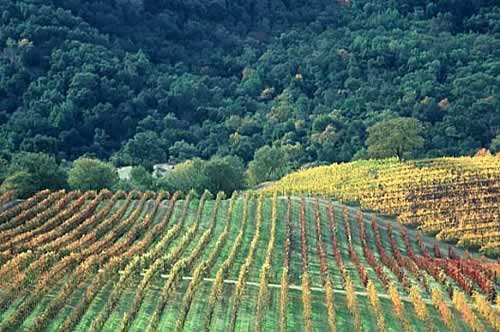
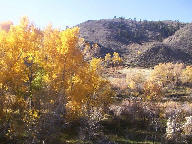
By November, a chill gradually fills the air as the days grow shorter. Carmel Valley vineyards take on red and yellow hues, while leaves slowly turn colors and break from the trees through December. It's not uncommon for fall colors to still be visible at Christmas.

January and February are the coldest months, with morning temps in the 20s. It's also our only rainy season of the year, with slow, steady downpours sometimes lasting several days at a time. Fortunately, it's a short-lived winter (if it can truly be called a winter by Midwest or East Coast standards), as March usually brings signs of warmth and renewal.

By March, blossoms are seen on trees and flowers, wildflowers bloom, and mornings are warm again. It's an unpredictable time, though, as cold mornings and rainy days still assert themselves from time to time.

Usually by May, the rains have stopped and we we have a few nice weeks of typical springtime before the grey fog of summer rolls in.

All things considered, it's an ideal running climate almost all year long.

I'm explaining all this as a preface to the manner in which I gauge the seasons: by the clothes I need to wear when heading out the door for a run. In our unorthodox climate, it's a much simpler way to mark the passage of time than looking at the calendar.

I'll detail this further in another post. But for now, just consider it the beginning of pants season.

Read more...

November 2, 2005

Back in the Saddle (Sort Of)

Against my better judgment, last week I decided to sign up for this weekend’s Big Sur Half-Marathon on Monterey Bay. Normally, this is right up my alley – a long distance road race through spectacular scenery, testing the limits of my fitness.

This year, however, will be different. I’m not nearly in good enough shape to attempt this race.

My two primary races of the year were August’s Pikes Peak Marathon, which took me 6 hours to complete, and October’s Firetrails 50, my first 50-miler, which took almost 9 hours. Training for these races entailed a lot of long, steady distance running, but almost no speed work.

As a result, my body is very accustomed to a slow pace, multiple walking breaks, and negotiating steep hills over treacherous terrain. On the other hand, my fast twitch muscle fibers have long since gone into hibernation.

So last week, I tried to wake them up.

On Thursday I showed up for my first track workout in months, and ran 5x1000m. On Saturday, I did a 4-mile tempo run as close to my lactate threshold as I could tolerate.

Both workouts felt miserable. But as I was laboring through them, I had a similar thought each day: I missed this.

There’s an entirely different dynamic to running when you are pushing the limits of your engine, struggling to keep pace with fellow runners when your natural inclination is to slow down. Compared to training for ultras, it’s really a whole different sport.

Although I love the ultras, I’m not quite ready to give up the road racing yet.

Sunday’s race will definitely be difficult and painful – both in a physical sense (dealing with the shortness of breath in my chest and lactic acid in my legs) and an emotional one (watching countless runners that I beat last year pass me by).

But despite the difficulty, I already know what my overriding sentiment for the day will be: I missed this.

Then I’ll spend the winter on the roads, building up to the high mileage weeks, and come back ready to roar in the springtime.

Read more...

October 25, 2005

First Day of Pants

I hadn't run for more a week after finishing last weekend's 50-miler, so on Saturday I headed out for an easy neighborhood run.

I had been feeling pretty good during the week, so I was somewhat surprised at how absolutely terrible this run felt. Everything ached - every muscle group in my legs was sore, and I felt like I had gained about 30 pounds (10, I could believe - but 30 seemed high even for a binger like me.)

The run was only 4 miles, but it felt like 40. I guess I shouldn't be surprised. After all, running 50 miles must take its toll on the body somehow, right? I misread my lack of resting soreness as a sign that I was ready to run again.

A full recovery will probably take weeks, but that's OK by me - I've got nothing on the calendar until springtime.

Additionally, today was the first day of the year that I had to wear long pants. California's central coast has a generally mild climate and somewhat different seasons than the traditional calendar would indicate.

We seldom have tempurature extremes, or severe weather like thunderstorms or blizzards, so I keep track of the seasons by what I need to wear for my morning run. I'll write more about this later.

But today was the first day of pants...and it finally feels like autumn.

Read more...

October 21, 2005

Yasso This!

Reading about Jeff's track workout got me to thinking...

I'm beginning to dislike Bart Yasso.

He's the Runners' World contributor who came up with the smarty-pants theory of predicting marathon times based on 800-meter interval track workouts.

The theory is this: during the course of your marathon training, include a weekly track session of 800m repeats. Build up the number of repeats until you do a workout of 10 repeats, with a rest break equal to the interval time between each one.

Whatever time you can run consistently for ten repeats corresponds to your marathon time, by changing the units. For example, 3-and-a-half minutes equals a 3:30 marathon. If you run them all in 2 minutes, 50 seconds, you're in shape to run a 2:50 marathon.

Sounds simple, right? And according to the RW website, this formula was tested on hundreds of runners, and holds true all the way up and down the line, from 2:10 marathoners to those who need over 5 hours.

The problem is, I have tried this particular strategy several times, and have never even come close to my predicted marathon time. The closest numbers I have ever put together were a 3:03 marathon at Napa after running ten repeats of 2:49 to 2:53.

I have also used this formula in preparation for marathons at Humboldt, Los Angeles, Big Sur, and San Francisco, with similar disappointing results. The rest of my training included all of the usual recommendations- long runs, hill training, easy days, tempo runs, etc.

So...am I the exception to the rule, consistent over six different courses? Or is there something more complicated than meets the eye? And how can you predict uncertainty, anyway?

The Yasso formula had me so screwed up that sometimes after a marathon I was unsure whether I should feel good about it, or be discouraged.

I typically use a heart rate monitor to pace myself in marathons, and I typically run withing a few minutes of even splits nearly every time. So even if I run an evenly paced 3:09, and kept a solid effort throughout the race, Yasso's formula tells me I should have been at least 10 minutes faster.

That's a tough thought to contemplate on a long drive home after the race.

What I've decided is that there is absolutely no reliable way to predict what anyone's time will be on any given day, especially for a marathon.

Have you ever played team sports? f you were lucky enough to play on a good team, there were always some games where you could "take it easy", knowing you could probably win even without playing your best. A team's win-loss record can be deceptive, based on the quality of the opponents they had played - just look how screwed up the college football polls get every year.

Luckily, there are no such illusions with running. It is a brutally honest sport, both in training and on race day. I can't run fast without training hard. And even if I do all of the arduous work to prepare for a race, I have to produce an exceptional effort during the race to achieve a PR.

When I do attain a PR or any other particular goal, I know that it was hard earned and well deserved. I know there's no reliable way to predict a race performance, and no way to fake it. And I wouldn't have it any other way.

Read more...

October 20, 2005

Thanks to Dean and Dave

Every November, Mike Dove and I use our running column to express all the things we are thankful for.

This year, I'm definitely going to thank Dean Karnazes and David Letterman.

In March, Karnazes went on The Late Show to promote his book Ultramarathon Man. I had previously had only a passing awareness of Karnazes, seeing him in photos from running magazines.

Letterman was in good spirits, but seemed genuinely confused about whether to be amused or impressed by Karnazes's exploits. The interview was equal parts absurd and inspirational - not unlike the sport of ultrarunning, really.

I bought Karnazes's book and tore through it. For many years I had wondered if I could complete an ultra, and by the time I had finished Ultramarathon Man, I was absolutely convinced it was possible.

I trained throughout the summer, and last week I finished my first ultra, the Dick Collins Firetrails 50 in Castro Valley. It was a beautiful race, and one of my most rewarding experiences in running.

I don't know if I'll continue my foray into ultrarunning, but I definitely know that I wouldn't have started when I did if it weren't for that Late Show interview. For giving me the impetus to start, I'm grateful to both of them.

So thanks, Dean. Thanks, Dave.

(The interview can be seen on Dean Karnazes's website here.)

Read more...

October 19, 2005

Great Moments in Spelling (Part II)

At long last, the day I circled on my calendar months ago had finally arrived: the 2005 edition of the Scripps National Spelling Bee! Five hours of coverage on ESPN, live from the Independence Concourse of the Grand Hyatt Washington in downtown Washington, D.C.


Why in God's name do they have this thing on a weekday? I mean, not all of us can skip work to watch year after year. What on Earth did people do before TiVo? The Scripps folks should have the Bee on a Sunday, like the Super Bowl, or on a holiday weekend, like the Indy 500. It's that important.

To commemorate the day, I compiled a real-time diary of random observations that occurred to me when watching this year's event. Herewith, a runner's thoughts on the 78th annual Bee:

10:02 (all times PDT) - Today's co-host: Katie Kerwin McCrimmon, winner of the 1979 National Spelling Bee. It's like having Frank Shorter doing commentary for the Olympic Marathon. I'm guessing she kept her maiden name so that people would recognize her: "are you that Katie Kerwin, from the 1979 Bee?" She's still basking in the glory, 26 years later. This has to be about as far as anyone can milk having "former National Spelling Bee champion" on her resume, right?

10:13 - The first seven spellers have all spelled their words correctly. There are a finite number of words used for each Bee, so there is always the possibility that the entire word list could be used up before all the contestants are eliminated, resulting in co-champions. It hasn't happened since 1962, but today we're starting out on course record pace...

10:14 - Nevermind. Maithreyi Gopalakrishnan just tripped over "lignapurdous" (something that destroys wood). Game on.

10:32 - Katherine Seymour is struggling with the word "incunabula" (books written before the year 1500). In the process of asking her permitted questions, she tries to slip in "How do you spell that?" The judge pauses and smiles, and everybody in the room has a good laugh, thankful for the light moment. Katherine then misses the word and is escorted offstage. The lesson: never lose your focus. It's a fatal mistake.

10:33 - I know this one! "Matutinal" describes an activity that habitually takes place in the early morning hours. I got this word a few weeks ago on my word-of-the-day e-mail from dictionary.com (thaat's right...insert your geek joke here), and I've been waiting to drop it in a column about running. I mean, my training group is definitely comprised of matutinal people. Way matutinal. They don't make 'em much more matutinal than us. Apparently Sahiti Surapaneni is familiar with the word also, as she easily nails it to advance to Round 6.

10:37 - Returning from a commercial break, ESPN shows the clip of the legendary "euonym girl", Rebecca Sealfon, who jumped up and down while shouting the letters of this final word to win the 1997 Bee. Quite simply one of the best Bee moments ever. It was like watching Alan Webb's high school record mile at the Pre Classic - an electrifying, unforgettable breakthrough performance by a young phenom at their absolute prime.
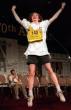
That type of performance at the Bee will never be duplicated. It's a lose-lose situation for any kid with the temerity to imitate that response on the final word. Spell it correctly, and you're just copying the girl from 1997. Miss it, and you look like a complete choker.

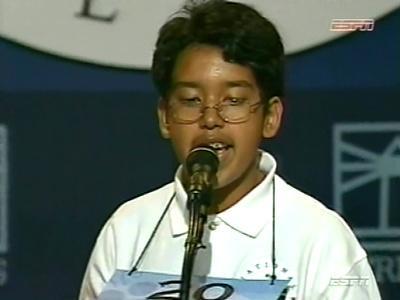
11:02 - 12-year-old Nidharshan Anandasivam is stumped by the word "muesli", taking almost all his allotted time before tripping up and omitting the "e". My goodness - muesli? That word knocked a kid out of the contest? I could understand if it were "Cap'n Crunch", with that unconventional p-apostrophe-n variant, but wow - "muesli." For the rest of his life, whenever he goes down the cereal aisle of the grocery store, this poor kid is going to flashback to his most disappointing moment ever.

11:33 - Monterey County has the Big Sur Marathon and the Wildflower Triathlon on successive weekends; in Washington, 11-year-old Bonny Jain finished 4th in the National Geography Bee one week before his appearance here at the Spelling Bee. I wonder how the training between the two events compares. Does studying for one event impact your performance in the other? There may be some good cross-training potential: after you manage to locate places like Uzbekistan or Kuala Lumpur, their names provide great opportunity to polish your spelling skills. Is fatigue a factor in entering back-to-back events? Did he purposely not taper for the Geography Bee, so he could stay sharp for the Spelling Bee? I'm full of questions about this.

Come to think of it, why don't these geography kids get more dap? The spellers have become superstars in recent years with movies and national TV coverage, so why is the Geography Bee neglected? They must be equally strenuous events. In fact, geography is probably harder in many ways - I don't remember any catchy rhymes like "i before e..." to help remember the highest point of each continent. It's probably a much larger volume of information to learn, with capital cities, rivers, mountain ranges, and relative sizes of every country. Geography kids deserve much more attention than they're getting (gosh, it's even more like triathlon than I thought).

11:38 - Every year, there are lots of musical terms (dolcissimo, pianissimo, notturno) and medical terms (pleurisy, trichinosis, spondylitis). People joke that the first step to being a great runner is to pick the right parents. I'm thinking if there were some kid with a doctor father and a concert pianist mother, he would be almost unstoppable in the Bee.

12:00 - 1:00 - Lunch break. 29 spellers left. P-R-E-S-S-U-R-E.

1:23 - After they hear their assigned word, some kids like Alexis Ducote and John Minnich turn their placards upside down and pretend to write the word on the backside. They aren't allowed pencils during the bee, but this practice helps them to visualize the word as it is written. Sports psychologists are always yammering at us runners to visualize success, and picture ourselves running strong and effortlessly. I've always thought it was bunk, but most of the kids who do this at the Bee end up spelling the word successfully. Ducote just nailed "persifleur" (one who indulges in banter). Maybe I'll give that visualization thing a try sometime.

1:48 - As contestants miss a word, they get escorted to the "comfort room" off stage. The cameras don't go there, which of course makes me wonder- what goes on back there? Are there free sodas and video games to cheer you up? Do they play Hilary Duff CDs and hand out stacks of Yu-Gi-Oh cards? Why can't they go interview the kids back there, like they do in the "kiss and cry" area with figure skaters who have just crashed a triple axle? There's a lot of ratings potential here.

2:27 - After Marshall Winchester is eliminated by missing "serang" (the boatswain of an East Indian army crew) in Round 11, the remaining four contestants are of Indian descent, guaranteeing us another Indian winner. This makes three years out of the past four with an Indian winner, and numerous second through fifth place finishes in the last five years. If the Spelling Bee were the Boston Marathon, these Indian kids would be like the Kenyans, increasingly dominating the event year after year. Am I the first person to notice this? Ten years from now, it will be a shocker if the winner isn't Indian.

2:38 -11-year-old Samir Patel has made the Bee look effortless to this point. Often, upon hearing a word such as "hooroosh", he asks some show-offy question about the definition such as, "Does that mean a great commotion?", or about the origin of other words like "Is that of Latin origin, translated from the Greek form?", which of course he knows are correct before he even asks them. He's in the final two and a clear favorite to win, but suddenly in Round 19 he stumbles on "roscian" (relating to or skilled in acting), and there is a collective gasp through Independence Concourse. The door is now open for Anurag Kashyap to win, like a patient runner who drafts the leader for the whole race before sprinting past him in the final straightaway.
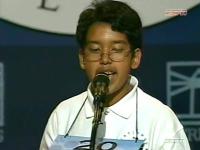
2:40 - Anurag nails "appoggiatura" (another musical term! It's an embellishing note one half-line above or below the note that precedes it) and claims the prize. Like last year's winner, David Tidmarsh, Anurag's response is to hide his face behind his placard and cry. What does it say about the stress of the competition that these kids are reduced to emotional wrecks- even the ones who win? Remind me to keep my kids away from this sort of thing when they get older.

2:42 - In his post-Bee interview, Anurag is asked to describe how he feels. He stammers for a bit before finally coming up with..."ecstaticness". What? Is that even a word? Apparently not, for he quickly corrects himself to say "ecstatic, sorry." After completely wrestling the English language to the ground, the kid finally bonked and went into multi-system shutdown. It's like watching a marathon runner run a strong race and pump his fists across the finish line, and then collapse and get carried to the medical tent by an elderly volunteer. He still gets to keep the marathon medal, and Anurag still keeps his trophy.

Watching at home, I can only hope he's headed for some refreshments and a massage tent somewhere. After his performance today, he certainly deserves it.


See other installments of this series on sidebar at right

Read more...
Related Posts with Thumbnails

  © Blogger template The Professional Template by Ourblogtemplates.com 2008

Back to TOP