November 17, 2005

Strikeout

I meant to run today. Really, I did. But it seemed like the fates conspired against me.

Strike 1: I just couldn't get myself out of bed this morning. I can usually string several days of getting up early in a row, but occasionally I simply need the extra hour of sleep more than I need a short run. Besides, I can always run at luchtime, right?...

Strike 2: "Code Triage" was called at about 11:00AM at the hospital where I work. It's essentially a disaster-preparedness drill, with all involved parties required to attend a debriefing, which of course extended into the lunch hour. Thankfully, it ended early enough that I still had time to squeeze in a short run...

Strike 3: the 64-oz water bottle that I left in my exercise bag wasn't properly sealed, and had been leaking into my running clothes for the past 4 hours. Everything I intended to wear was drenched, and I had no spare clothes.

Deciding against putting on soaking wet clothes to run in the breezy autumn afternoon, I called myself out for the day. Which means that since my promising run on Tuesday, I've run a grand total of 4 miles.

But tomorrow is another opportunity to do better. As long as I don't do anything stupid.

Read more...

November 16, 2005

Iron Envy

Yesterday's small dose of mojo came at a price - today one of my hamstrings was so sore that I could barely hobble through 4 flat miles.

So I might as well talk about the Ironman.
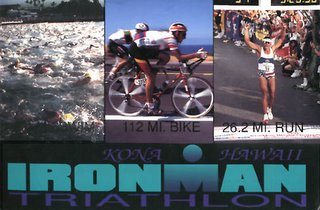
I watched the Ironman Triathlon World Championships over the weekend, and as always, came away with mixed emotions.

First, let me say for the record that I LOVE the Ironman. Just adore it. It's probably the most demanding athletic event in the world. It's been on my athletic "wish list" for several years now, the same way the Boston Marathon used to be before I finally qualified and ran it.

But NBC's coverage of the event drives me bonkers. Here are my main gripes:

1. Al Trautwig's completely over the top dramatization of every aspect of the event. Sure, his delivery is great for the stories of athletes who have overcome hardship to compete, but seeing athletes moving through the transition area doesn't always have to be presented like Greek theater.

Thankfully, for portions of the telecast NBC utilized the services of Phil Liggett, otherwise known as the voice of the Tour De France. They don't make commentators any better than Liggett. He's knowedgeable, passionate, and enthusiastic about the events he covers. He could be working the National Barbecue Cookoff and make you excited about it. His style is dramatically different than Trautwig's, and very refreshing, so - nice move, NBC.

2. Last year NBC made a big deal about saying all the competitors were just a number (like a bib number) until they crossed the finish line in Kona, at which point they became Ironmen. The point was that no matter who you are, you have to deal with the same circumstances as all the others to get to the starting line and compete at Kona.

Which would be a nice thought...if only it were true. However, if you happen to be a former professional football player, television reporter or Baywatch star, there's a slot with your name on it at the starting line, just for the asking.

I understand that this helped increase exposure for the sport in the early days. But I don't get why they still use this gimmick. Is there anyone out there that really doesn't know what the Ironman is, or not respect how demanding it is to finish? It seems like they have an established audience now, and aren't reliant on celebrities to increase their viewership.

3. The overriding sentiment throughout the broadcast is usually something along the lines of, "These are everyday people who had the ambition and drive to take on the Ironman." In other words, if you had the same talent and drive, you could be there with them.

And yet, triathlon's crown jewel excludes vast numbers of people. To start with, it's extremely cost-prohiitive, when you consider the expenses of equipment and race entries beforehand, and travel to Hawaii (usually with family) for the event. It's even expensive to particpate in the lottery proces each year, which is the primary means of entry for many of the athletes.

Qualifying slots for the race are brutally difficult to obtain, and only the top fraction of athletes gain entry this way. I know that the event can't beome much larger than its current size, but wouldn't a qualifying system based on age-graded times, like the Boston Marathon uses, make much more sense? It seems that too many gifted competitors are being left at home, especially in light of the whole celebrity-entry issue I mentioned above.

So in addition to being courageous and determined, you also have to be rich and/or very lucky to get into the Ironman Hawaii. Somehow that doesn't get mentioned too often.

Yet despite all these things, I watch that darn show year after year. And I always go through a similar progression, from cynicism, to envy, then admiration, then inspiration, and finally come away marveling at what a fantastic event it is.

There's just no way to see those athletes taking on an ultimate challenge, struggling to continue as the day stretches into night, and not feel completely inspired to challenge yourself in a similar manner.

Watching the Ironman always reaffirms my appreciation for the ability of the human body to persevere and overcome tremendous hardships - a lesson many endurance runners eventually discover and cherish.

So congratulations to everyone who participated. I was thankful for the opportunity to watch you on TV last weekend. And hopefully someday many years from now, I'll be there competing alongside you.

That way, I won't have to watch it on NBC.

Read more...

November 15, 2005

The View From the Front

This morning our training group did our regular Tuesday run, a hilly 13-mile loop through two adjacent valleys in Steinbeck Country, an area the late author famously named "The Pastures of Heaven" (pictured).

Our two fastest runners were absent, and the rest are in tapering mode in preparation for the California International Marathon in 2 weeks. They would be taking it much easier than usual today.

Which meant I could probably keep up with them.

Normally I can hang with this group, but lately my speed has been lacking, as I've explained before. I was happy to be able to stay in the pack as we strung out across the major climb from miles 4.5 to 6.

Down the backside of the hill, I let my legs turn over more quickly, and slowly pulled ahead of the others. I figured it would only be a few seconds before they caught up to my pace once we were on level ground again.

Then the weirdness started. One mile later, I was still running by myself. Glancing over my shoulder, I saw everyone in the distance, but not gaining any ground. Knowing they were sure to catch me soon, I kept my stride comfortable and didn't overexert myself trying to hold them off.

Another mile went by, and another, and I realized that I was going off the front. The group had strung out now, and only one other runner was in sight behind me.

Just to clarify: any one of those guys could have reeled me in. They just decided not to.

So I assumed the mentality of a frontrunner.

I've pulled away from this group at other times, usually when I'm in much better shape or when the others are plodding through very high mileage weeks. But it hasn't happened since last spring, and the feeling was unusual at first.

Running off the front changes your perspective, and instills a sense of confidence, regardless of what speed you are running. If you pull away from a pack of 10-minute milers by running 9:30s, the feeling is probably the same as I felt stringing together 6:30s this morning to lead the pack home.

Although the pace started hurting with about 5K to go, my determination to hold off the pack propelled me through the final miles. When I inevitably began to tighten up in the last mile, I was far enough ahead that I could cruise to the finish and still feel great about my overall effort.

When I clicked the stopwatch, I found that I had run about 4 minutes faster than last time. And at that moment, I felt a trace of my long-lost mojo coming back.

Sure, everyone else was taking it easy this morning. At this point, I'm taking every moment of encouragement I can find to eventually regain my groove, and today's run was just what I needed.

Read more...

November 11, 2005

Bad Juju

Karen’s post about race shirt rules reminded me of an article I wrote for our running club about how marathon runners should avoid bad juju on race day.

Juju is a term that is adopted from African culture and has various meanings.

It is not exactly superstition. It can be a charm or object with magical powers, or any ritual act that influences the forces of nature for better or worse.

As it relates to running, juju is a specific behavior that really shouldn’t have any affect on race performance, but inevitably does.

Acts that directly affect physical performance, such as inadequate training, improper race preparation or foolish strategy, do not count. For example, wearing a new pair of shoes on race day or eating something unfamiliar before the race isn’t bad juju, it’s just stupidity.

Experienced marathon runners are careful to avoid bad juju before and during their event. The following are the most common examples:

Rule #1: predicting your own race time is bad juju. This is the “pride goeth before the fall” postulate of juju. On race day, there are too many variables that can conspire against you, to assume that they will all come down in your favor.

Nevertheless, runners of all speeds frequently break this rule. As soon as you state “I will run in x amount of time”, you are almost guaranteeing yourself a finish time that is much slower.

Try this experiment: ask a veteran marathoner how fast they are going to run an upcoming race. If they know anything about juju, they will hem and haw and be more evasive than Mark McGwire in giving you a specific answer.

To avoid bad juju, never forecast a specific time. It’s much safer to say, “I’m hoping to run x time,” or “My goal is to run it in x time”; statements that don’t tempt fate nearly as much.

Rule #2: wearing the shirt of the exact race you are running is bad juju. This falls under the “don’t count your chickens before they hatch” category of juju. It’s never acceptable to wear the t-shirt for the race until after you have actually completed it.

Just because you show up at the marathon expo and pick up your packet doesn’t guarantee that you’ll finish the race the next morning. Unforeseen injuries, stomach cramps, blisters, or a myriad of other problems can quickly lead to a DNF, and there you’ll be at the side of the road, advertising the event that just kicked your butt.

It would be like the losing team deciding to go ahead and wear those “Super Bowl Champs” hats that are printed in advance for each team, but only given to the winners. How ridiculous would that look? That’s the risk you run by wearing the race shirt during the actual event.

(By the way, what happens to all of those unusable hats and t-shirts? Hopefully they are sent to impoverished villages that don’t have TV or Internet access. There must be a whole society somewhere in a remote corner of the world that thinks the Buffalo Bills won four Super Bowls).

Rule #3: wearing the shirt from one race while racing in another is bad juju. The worst mistake a runner can make is underestimating or disrespecting any given course.

In order to race well, you have to focus all of your energy on the challenge at hand, and not look ahead to the next race, or dwell excessively on a past event.

Wearing the shirt from another marathon demonstrates conflicting interests and loyalties.

It’s the equivalent of going out to a special dinner with your girlfriend, while wearing a sweater that was an anniversary gift from a previous lover, and having your current girlfriend recognize it. This is the “how can you be committed to me when you’re thinking of another girl?” tenet of juju.

The only exception to this rule that may be considered is if the race distance of the shirt you are wearing is longer than the distance you are currently racing. Some people do this to psych themselves up during rough stretches, saying, “If I finished that race, I can finish this one.”

However, this is a pretty unreliable argument, as I have passed many people wearing Ironman singlets or Western States 100-mile race shirts who looked desperately exhausted while racing at the Big Sur Marathon.

Rule #4: Telling your finish line posse that you’ll be done at a certain time is bad juju. This is a more severe variant of Rule #1. It could be called contagious juju because it affects not just you, but everyone who is awaiting your arrival at the finish line as well.

Imagine the worry and embarrassment inflicted on your spouse and friends when they are looking for you, but you are nowhere to be found. Progressively bad thoughts cross their minds for every minute you are over your predicted arrival time.

When you finally arrive, instead of finding people who are sympathetic to your bad day, you’ll be facing an angry or stressed-out mob. Instead of being a hero, you are merely late, and a bearer of bad juju.

To avoid this plight, give your loved ones an “approximate window” of arrival times.

These are the most obvious cases of bad juju in action, but I’m really just scratching the surface with these examples. While there is no rational explanation for these phenomena, I have had enough experiences and observations to believe in the power of juju.

As race day approaches, don’t ruin all of your hard training with foolhardy behaviors that can tip the scales of karma against you. After all, running a marathon is hard enough on its own.

Read more...

November 10, 2005

The Voice of Reason

Knowing that it will be a long process to develop my "speed legs" again, I figured I might as well get started at the track today to see how I felt, and establish a point of comparison for the future.

I decided on my marathon-training staple, 1600m repeats.

When I'm in fighting shape, I can click off six or seven of these in the 5:50s or better. For today's workout, I gave myself a guideline that whenever I topped 6 minutes for a repeat, that would be the end of the workout.

1st 1600m: 5:56, at approximately 85% of max effort. So far, so good, although I have a feeling the other shoe is about to drop, so to speak.

2nd 1600M: 5:58, at 90-95% effort. A very quick transition from "comfortable fast pace" to "My gosh, this is harder than I remember" by the final lap.

3rd 1600m: 5:59, but only after an all-out race effort during the last lap to make up for drifting gradually off the pace during the first three laps.

A very old woman is bundled up in a jacket and hood, walking laps very slowly in the outside lane. Our paths merge as I'm walking to recover from my 3rd repeat. I'm panting, moaning, gasping for breath, and weaving across the lanes. Which leads to the following exchange:

Old lady: "It looks like you've done enough already."

Me: "Um...yeah, probably."

But as I slowly jog into the recovery lap, I think maybe I have a bit left in me. So I try another 1600, which becomes...

800m: 3:05. There was no way I was going to break 6 minutes, and I was completely out of gas. Workout over.

2 very humble cool down laps later, I give a wave of acknowledgement to the old woman, and head for my car.

She was right. I should have stopped sooner.

Read more...

November 9, 2005

November Rain

I woke this morning to the sound of rain on my roof, which was good news for two reasons:

First, I love running in the rain. It rains so infrequently around here that the occasional showers don't become depressing. And in the character-building sense, I feel like mileage run in the rain deserves extra credit in some regard.

The main reason I got excited is that this weekend several of my running partners are joining me on a 2-hr trail run here in Carmel Valley. It's an annual event to celebrate the autumn season.

Towards the end of the run, the trail leads down to the Carmel River, and the runners have to cross without benefit of a bridge. The river is about 40' wide at this time of year, and when the water level is low in the summer, its fairly easy to hop from stone to stone and stay dry all the way across.

During the winter, the rocks will be completely submerged, and the river becomes impassable unless you wade in up to waist or chest level.

I like the crossing best during the transitional period of autumn, when the tops of the rocks peek out over the current, and you're never sure if the next crossing will be your last for the season.

That's when I invite my friends to run the trails with me. Occasionally some of them topple into the water, but the river is still shallow and the failed attempts are received with more applause then laughter.

The run instantly becomes more memorable when several people get their feet wet. But this year, the water level seems lower than usual, so I've been hoping for some rain to make the crossing more of a challenge.

And this morning it happened. So I went outside and did my 5 miles, and looked forward to celebrating the season again this weekend at the Carmel River crossing.

Read more...

November 8, 2005

Not quite ready

Despite significant soreness in my legs, I was planning on getting out of bed this morning to run. But a couple things happened along the way...

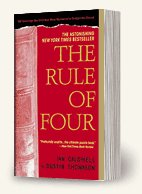
Last night, I sat down with The Rule of Four, a novel I had been pecking at for the last couple of weeks. Before long, I was two-thirds of the way into the book, and found myself sucked into the vortex of the story, unwilling to set the book down again as the hours grew late.

The problem is, it's not a real fast read. The plot is convoluted and complicated, drawing heavily from obscure 15th century literature, intertwined with modern-day academia. Cross The DaVinci Code with Ivy League esoteria, and you get the idea.

And yet, it's a great book. And I'm a sucker for great books. So I didn't get to sleep until the book was finished, a few hours past my usual drop-dead bedtime.

So when the alarm went off this morning, and I was sleep deprived, and it was dark outside, and I could still feel the pain in my legs from Sunday's race just by stretching my legs...well, I didn't have a chance, really.

I actually don't feel too bad about it. Unfortunately, it's a pretty rare book that hooks me and carries me along into the night at the expense of sleep and running. When those moments occur, they are definitely worth missing a morning's run to savor them.

But tomorrow, I'll be back on the road.

Read more...
Related Posts with Thumbnails

  © Blogger template The Professional Template by Ourblogtemplates.com 2008

Back to TOP