February 20, 2006

Leap of Faith

Everybody has days when they would rather stay in bed than venture outside in the cold early morning for a long training run.

Disciplined runners usually overcome their early morning inertia and drag themselves into the scheduled workout. They know that each time they overcome the urge to skip a workout, they build mental toughness that will be needed on race day.

But this isn't a story about disciplined runners - it's about me.

Sunday morning was one of those days. When the alarm went off at 4:30, my body felt like lead. I lay in the dark for a few minutes, then crawled out of bed and checked the thermometer: 33 degrees.

“Well, at least it’s not freezing” I thought, and went about gearing up for my scheduled 22-miler. But the desire to stay in bed never diminished, even as I headed down the driveway into the crisp darkness.

Usually once I start running, I forget the notion of remaining at home, but that thought never left my mind on this particular morning.

My first steps were quite painful, particularly in one hamstring that has been bothering me for several weeks now. I’ve mentioned this persistent injury only a couple of times in this blog, but not dwelt upon it yet – I’ve been (perhaps foolishly) hoping to keep it a non-issue in my marathon buildup.

But a half-mile later, the leg was hurting me even more, and the prospect of 22 miles seemed overwhelmingly daunting. This is the point where disciplined runners typically overcome such mental hurdles and press onward.

As for me, I stopped in my tracks. I considered my options, then turned and headed back home. I returned to my house, changed my running gear for my pajamas, and climbed back into bed.

Once I made it out of bed again at 8:00, I replayed the decision over and over all day long. Although it’s a stretch, I’m keeping a cautiously optimistic outlook on today’s development (I even changed the working title of this post, which was “Panic Mode.”)

My injury isn’t catastrophic, but it’s certainly enough to derail my marathon preparation if I don’t give it the attention it deserves. Although it has limited my overall training volume, I’ve still been able to do several hard workouts each week, as long as I kept the other days very easy.

This weekend I made the mistake of planning two tough workouts in a row. I knew it might not succeed, and that shutting down one or both workouts would be an option I’d have to consider.

I’ve done long runs for each of the past several weekends, and now the Napa Marathon is only two weeks away, and it’s time to start tapering. I won’t lose too much fitness in these weeks, and the easier workload should help my injury heal sufficiently for me to race well at Napa.

At least that’s what I keep telling myself. Luckily, I’ve been down this marathon road enough times to know that one missed workout won’t affect the outcome, and that I can still be ready if I play my cards right.

The problem is, you never really know for sure if your decisions are the right ones until you are standing at the start line, or feeling the first miles of the race. For now, the skipped workout was a leap of faith. Instead of feeling well-prepared, I'm going to keep things very conservative and see what happens.

It looks to be an interesting couple of weeks ahead.

Read more...

February 18, 2006

Show Them the Money

Jeff posted an interesting comment to my article about the Winter Olympics, asking for my take on allowing professional athletes to compete. In the midst of a long-winded reply, I figured I could make a whole post out of the topic.

It seems like the issue of professionals in the games primarily revolves around two high-profile sports: basketball for the Summer Games, and hockey in the Winter Games. Everybody remembers the days when our amateur b-ball teams would routinely kick the rest of the world around, and anybody over the age of 5 in 1980 probably remembers the whole country going nutty about the “Miracle on Ice” hockey team at Lake Placid.

Like everyone else, I have a soft spot in my heart for that team, both for their athletic achievement, and for the galvanizing effect they had on the entire country at a time when we desperately needed it. To this day, I can’t watch footage from the USSR game or sit through the movie “Miracle” without my eyes getting all watery.

But for the time being, let’s forget about basketball and hockey. What about the athletes in all the other sports? I would guess that for the majority of them, the concept of “amateurism” is an anachronism, and that’s not necessarily a bad thing.

For example, consider the plight of most runners. How many of us wouldn’t love to have a portion of our living expenses paid for, so we could have one extra day off work per week to sleep in before training, do a second workout later in the day, or just take a nap whenever we felt like? And how much cooler would it be to have enough sponsor support that we didn’t have to work at all? How much better a runner would you be?

While the number of runners who are fortunate enough to be full-time athletes is quite small, it is necessary for long-term development of our best athletes. It also provides runners a much longer and potentially more fruitful career than they were allowed 40 years ago.

I wrote a a series of articles one summer about Roger Bannister and other great runners of the 1950s, and mentioned how all of them retired from the sport at a very young age. There was simply no money to be made in the sport - even though milers were the most popular athletes in the world.

Bannister was only 24 when he hung up his racing cleats for good. Could he have won an Olympic medal if he stayed in the sport another eight years? Nobody knows, but for Hicham El Guerrouj, those extra opportunities made the difference between being remembered as the greatest miler of all time instead of a heartbreaking failure.

Bannister was a medical student while he trained as a world-class runner. How much faster could he have run if he had sponsorship revenue to support him, so he could postpone medical school for a few years?

The notion of pure amateurism was frequently nonsensical, anyway. America’s best hope to break the first 4-minute mile, Wes Santee, was once barred from further competition because he accepted a wristwatch as a prize for winning a race (It wasn’t even a Garmin – just a regular old watch). Could this type of enforcement exist today? And how exactly does it benefit the runners?

I’m not throwing all of the old ways under the bus. Quite the opposite: I’m about as old-school as they come when it comes to sports, especially the Olympics.

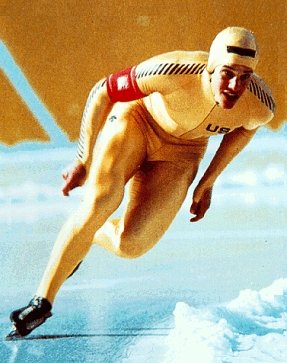
(In fact, I’ve never been more disappointed in an American winter team than I am about this current one. Seriously – do you think 10 years from now people will regard Apolo Ohno, Johnny Weir, and Bode Miller in the same way they do Eric Heiden, Bonnie Blair, Scott Hamilton, or Bill Johnson? It seems like they’re more concerned about being celebrities than winning medals. Two words: Lindsey Jacobellis.)

But on this topic, I think having professionals compete is a natural, inevitable progression. If our guys don’t spend every waking minute training, they’ll lose to somebody who does. The line between amateurism and professionalism, if it even exists anymore, has been blurred beyond distinction.

Finally, back to that Miracle on Ice game: I’ve always considered it the athletic equivalent of landing a man on the moon. We’ll probably never again see such a perfect confluence of political tension, athletic accomplishment, and global theater. I feel privileged to have seen it, because I don't think we'll see a situation like that ever again.

The fact that the Americans were amateurs was only one portion of the formula. More important was the way they represented the letters on their jerseys, and the pride and glory they earned for themselves - and by extension, for all of us watching.

That’s still what the Olympics are all about. Regardless of whether or not the athletes are paid.

Read more...

February 16, 2006

Winter Wimp

For conclusive evidence that this California boy wouldn’t last one season in a serious winter climate, read on…

My wife has spent the past few days refinishing an old dresser, using our carport as her outdoor workspace. I’ve parked my car outside on the driveway since the beginning of the week.

These would normally be unremarkable developments, except for the fact that the temperature dropped to 29 degrees last night. I climbed into my car at 4:45 this morning and stared dumbfounded at the strange white stuff on my windshield. When my wiper blades failed to clear it off, I knew I had a problem on my hands.

I turned on the engine and cranked the defroster, then got out of the car and entered the storage area under our house. I was looking for one of those, uhh, thingies that I’ve seen people on television shows use to scrape ice off their windshields.

It took me almost five minutes to conclude that since I haven’t ever used a scraper in the ten years that I’ve lived here, the odds of my finding one amongst the tools underneath my house were pretty slim - especially if you’ve seen the way I store my tools.

Time for plan B. I tore apart one side of a Kashi cereal box, took the cardboard outside to the car, and started scraping off the windshield (MacGyver would be proud). It wasn’t until I climbed back into the car with icy fingers that I realized the back windshield was also iced over.

Since I had to back out of our curved, sloping driveway in the dark I figured it would behoove me to be able to see out the back window. I climbed back out, scraped some more, and froze the fingers on my other hand before getting back in the car.

About fifteen minutes had passed since I first came outside. I arrived a little bit late for our group’s workout and had to cut a mile off of my warmup, so I only got to run 12 miles this morning instead of thirteen.

God, I hate winter.

Read more...

February 15, 2006

The Napa Chronicles, Volume 2

In 2001 I was determined to conquer the Napa Marathon.

My goal one year earlier had been to break three hours, but I didn’t take the race seriously enough, and came up a few minutes short (or long, as the case may be), finishing in 3:03. I took it as a learning experience, and committed myself to better training and smarter preparation the following year.

During the winter, everything went according to plan. I had run my fastest marathon in December 2000 (where else, but at Cal International), then taken a couple of easy weeks before resuming high mileage training weeks.

January and February rolled along smoothly, without any injuries or major setbacks to my training schedule. I tapered for two weeks prior to the race, and went to Napa in early March in prime racing condition.

I hadn’t counted on the weather.

The first week of March 2001 saw one of those wickedly nasty Canadian storms sweep down the American west coast and remind us Californians why we could never live in Canada. The wind was cold. The rain was colder. The sky stayed dark for three days.

I remember lying awake in bed at midnight in my hotel room the night before the race, listening to the storm howl through the windowpanes of my hotel room, and thinking, “This isn’t starting well.”

Race morning brought a slight lull in the storm, just long enough for runners riding the bus to the start line to think that maybe we would be spared the worst weather during the race. I clung to a glimmer of hope that today would be a great day for racing.

Those hopes were dashed as soon as we got off the bus and felt the prevailing wind. It wasn’t terribly strong, but it was a headwind. Napa is a point-to-point course. That’s a bad combination.

Just prior to the starting gun, light rains started again, and we set off directly into the path of the gathering storm. I wasn’t exactly optimistic.

Yet I was still determined to make a race of it. I stayed on my goal pace through 5 miles, then 10, and on through the halfway point. I first got nervous when I looked at my halfway split and saw it was 1 hour, 29 minutes.

I was right on pace, but I already knew that I was working way too hard to maintain it. To make matters worse, the storm was intensifying.

During the second half of the race, I faced the absolute worst weather conditions I have ever seen. The rain came down in sheets. The headwind was steady in the 30mph range, with gusts greater than 40mph. The temperature fell into the 30s.

The race in general, and my race in particular, came apart at the seams. Aid stations had to be collapsed because cups were flying off of tables that couldn’t be secured to the ground. Spectators smartly abandoned the course in droves. And I was working harder than ever just to run 8-minute miles.

(The only positive thing about this weather was that it was the runner’s version of the perfect storm - almost certain to never be duplicated. A few of my training partners ran the race also – and now, whenever we’re running in foul conditions, someone invariably says, “Well, it’s not as bad as that year at Napa.” It’s like we had this rite of passage together that bonded us in toughness. Or maybe we’re just too emotionally scarred to talk about it rationally.)

The final 10K was simply a miserable ordeal. I crossed the finish line in 3:14 and immediately staggered into the medical facility, shaking uncontrollably and unable to speak. I had a lot of company there. Many of us wore a shocked gaze, like we had climbed out of a train wreck and just wanted to feel ourselves breathe for a few minutes to confirm that we were still alive.

The physical pain gradually subsided over the next several hours, but the psychological bruises took much longer to heal. I was emotionally devastated that I had prepared so well for a race only to see it blow up for reasons I couldn’t control.

I couldn’t think rationally. I considered my bonking in the final miles not a sign of running too hard early, but of not having the toughness to hang in there late in the race. I wondered if I was too fragile to be a marathon runner.

Worst of all, the race sent me into a bit of long-term depression. I started questioning why I placed so much emphasis on running a certain time, or for that matter, why I cared about races so much anyway. It seemed like there were a lot of other ways I could spend my time that weren’t so all-consuming.

Some of these effects were prolonged. I couldn’t motivate myself to stay in training mode for that April’s Big Sur Marathon, and ran one of my slowest times ever at that race. I did a few more races in 2001, but I was never in proper race condition and struggled through all of them.

And it would be four years before I could bring myself back to Napa again. That's where we'll pick up volume 3 in a future post.

Read more...

February 13, 2006

My Valentine

With today being Valentine's Day and all, I feel compelled to write a little bit about my valentine of 17 years and my wife of almost 12 years.

Thankfully, they are the same person.

(My motivation isn't pure altruism - she's been known to read this blog from time to time, so let's just say another generic post about running today would be ill-advised.)

We met as undergraduates at UCLA in my first year of college, and her second. We lived on the same floor of our dormitory, but never really spoke for almost the entire school year.

I was on the rowing team, and the spring was racing season. Our crew was favored to win the West Coast Championships that year. As a sign of toughness and solidarity, our entire boat shaved our heads before the championship race.

We would have looked like studs if we won. It was a great plan except for one thing...we forgot to win the race.

When we returned to campus, I was disconsolate. Sulking one night in the lobby of our dorm, wallowing in anger and disappointment, I heard a sympathetic voice asked me what was wrong.

I gave her the short version of the story. I didn't really feel like getting into it.

After successfully breaking the ice, she asked if she could rub my head. So, OK...a pretty girl asks to rub my head...I guess the least I could do was play along to avoid offending her.

We sat in the lobby for a few minutes like that, one stranger rubbing another stranger's shaved head. She said it felt neat. I started to forget how angry and upset I had been.

It wasn't exactly love at first sight. It took us another several months before we started dating, and several years before we got married. (Remember how I said I usually make blink decisions? One notable exception was marriage - that was a long, petrified stare analyzed from every imaginable angle. Some things deserve a second look.)

We were married in 1994, and it's generally been a "happily ever after" situation. And honestly, it hasn't been an equal distribution of responsibility - I've gotten the better end of the deal by far.

You know this whole running thing about which I feel so passionately and write so frequently? In all likelihood, 95% of it doesn't happen if she's not supporting me. The only reason I'm able to get out of the house on any given early morning is that I know another parent (OK...the better parent) is holding down the fort.

With my running adventures, I've sometimes pushed the envelope of her support more than I like to admit. There have been times when I've come home from overnight race trips half-expecting to find her Googling divorce attorneys. But she's always taken the high road of tolerance and forgiveness.

We go round and round about how much running and racing I should do. She's always sensible. I'm typically out of my mind. I think if I didn't have her as a balancing force, I'd probably get injured or burned out, or bankrupt us with all the things I'd love to do. She's almost always right. I almost never say so.

Since we've been married, there's never been anyone else that I'd rather share my life with. And despite my well-documented affection for music video vixens like Beyonce or the Pussycat Dolls, there's honestly nobody I'd give my romantic affection to besides her.

All in all, she's a great valentine.

(And if you're reading this...Happy Valentine's Day, sweetie!)

Read more...

Firefly

“As the sun set a little firefly was born. It stretched its legs and flew off into the darkening sky. It was a lonely firefly and it flashed its light searching for other fireflies.” – Eric Carle, The Very Lonely Firefly

My long weekend training runs typically start very early. I like to be home in time to spend breakfast with the family, get cleaned up for church, or get started on projects around the house.

For the past few weeks I have done my long runs in the 7,000-acre Fort Ord open space located between Monterey and Salinas. I’ll usually put in about 7-8 miles by myself before meeting others in our running group at daybreak to complete the remaining mileage.

Almost every long run begins in stark darkness. When I run on trails, I use a headlamp to light my path, but the cocoon of light grows quite isolating, and sometimes I’m grateful to hear or observe any signs of life that might occur around me.

“The firefly saw a light and flew toward it. But it was not another firefly. It was a car’s headlights flooding the night.” – E.C.

The first two miles are on a dirt path that runs parallel to the two-lane highway connecting the towns of Monterey and Salinas. Occasionally a car will drive on the road while I’m on the path, but I know I’m virtually undetectable running behind the row of pine trees under cover of darkness.

“The firefly saw a light and flew toward it. But it was not another firefly. It was a lantern glowing in the night.” – E.C.


One side of the open space is flanked by a housing development, and as I climb the first hilly fire roads into Fort Ord, I can see sparse bedroom or kitchen lights casting a dim glow from afar. I know the people inside are slowly awakening, but completely unaware of my faraway presence in the shadows outside their shelters.

“When all was quiet, the firefly flew through the night flashing its light, looking and searching again. Then the very lonely firefly saw what it was looking for…

A group of fireflies, flashing their lights.” – E.C.


On Saturday morning, something unusual happened. As I was climbing to a ridge, I saw flickering lights across a canyon, several miles away. By this time I was far out of sight of any development, so at first I didn’t know what to make of them. But then it hit me…

They were mountain bikers. Other athletes sharing the trails with me in the darkness.

I only saw the lights for a few seconds before they disappeared into the brush and I veered off in a different direction. Our paths never crossed later in the morning. I have no idea who they might have been.

But somehow, just knowing they were out there made me feel much less solitary than I was when I started the run.

It was comforting to know that there was somebody else crazy enough to explore the trails in total darkness. Their flashing lights were a distant affirmation that waking up at 4:30 for a solo trail run just to get my desired mileage completed isn’t really that abnormal – that for some of us, it’s just the way things have to be.

Clearly I’ve read too many children’s books, because as I continued on my way in the dark, and again as I met up with my training partners, the recurring thought in my mind was Eric Carle’s book, and the concise satisfaction of its final page:

“Now the firefly wasn’t lonely anymore.”

Read more...

February 10, 2006

Judges? We Don't Need No Stinking Judges

Author's note: In honor of tonight's Opening Ceremonies, I'm posting a rough draft of what will be a Monterey Herald article next week about the Winter Games.

I generally love the Olympics. There’s really no more inspirational and uplifting sporting event in the world.

So I’m looking forward the current Winter Games in, um,…what’s the name of that city again? I always thought it was Turin, as in “Shroud of Turin.” But NBC seems determined to call it Torino, like the Ford car from "Starsky and Hutch."

Did I miss a protocol change somewhere? Do we Americans now refer to the Italian capital as Roma, or the city with canals as Venezia? Or is NBC just trying to sound more sophisticated? If somebody could clarify this, I’d appreciate it. Maybe I just need to watch more Geography Bees.

Anyway, I’ll sit in front of the television most Olympic evenings, enthralled by the speed skaters and downhill skiers, and indulging my longtime passion of watching hockey.

I became a fan of cross-country skiing during the 2002 Games, after watching the 4x10K relay competition between Italy and Norway decided by less than a second, and learning that these same two countries have finished within a second of each other in each of the previous two Olympic Games. They’re like the Red Sox and Yankees of XC Skiing.

Invariably however, there are several winter sports which don’t hold my interest for very long- snowboarding, aerial jumping, and moguls to name a few.

The marquis sport of the Games, figure skating, doesn’t captivate me much beyond watching Michelle Kwan try to finally win the title that has slipped through her grasp multiple times before. Depending on what happens, she’ll either be the John Elway or the Jim Kelly of her sport – not exactly a small distinction.

Here’s my litmus test for following a sport in these Winter Games: any event where the result depends on style points, or scores given by judges, is far less attractive to me than those that involved traditional competition.

It’s clear that my obsession for running has heavily biased my perception and appreciation of other sports. Events where athletes or teams are competing head-to-head, or racing against the clock, just seem inherently purer, and more exciting.

One of the greatest aspects of running is its fundamental nature: go from here to there as fast as you can, using only your body. In fact, this quality is primarily what led me to embrace running over other endurance sports in my mid-twenties.

I had dabbled in bicycle racing for a while, but grew frustrated that I was losing to many people not because they were better riders, but because they had better equipment. Having the lightest, fastest parts and components makes an enormous difference, and it was a common expression to say that someone would get “out-biked” when losing to a competitor who had the advantage of using superior equipment.

I’ve never had that problem with running. Every single person who finishes ahead of me in a race is either in better shape than me, or executed a better race strategy than I did. Nobody I know has ever been “out-shoed” in a race.

The clock tells me precisely how well I performed, and exactly how I fared in comparison to everyone else. There is nothing abstract or biased about my finishing place. Watch any local 5K or 10K race, and you will witness the purest form of competition there is to be found.

Even some Winter sports that appear very objective have a subjective component that seems unnatural. For example, doesn’t it seem obvious that for ski jumping, the winner would be the one who flies the farthest? But the jumpers are also given style points based on their landings- which, unless someone completely crashes, all look remarkably similar to me. So instead of comparing the distances, the jumpers are given a composite “score” and ranked accordingly. Huh?

Thank goodness this standard doesn’t apply to running. Some of the greatest runners in history looked like miserable wretches at the time of their highest achievement.

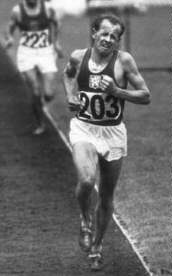
The great Czech runner Emil Zatopek (pictured), who won three gold medals at the 1952 Helsinki Olympics, often ran with his head cocked to one side, his tongue hanging out of his mouth, and his eyes bulging from their sockets. A famous description of him was that he looked like a man with a noose around his neck.

Steve Prefontaine ran with his head wrenched backward, flung his arms in every direction, and had a face of sheer agony during every one of his races. He tried to decide races based on who had the most guts, and he frequently defeated opponents who ran much more gracefully.

There is a long list of elite runners who during the course of a race have thrown up, relieved themselves, or become bruised and bloody in pursuit of their goal. How revolting it would be (even more so than the actual throwing up, relieving themselves, etc) if their accomplishments were considered secondary to those runners who looked more sophisticated while running more slowly.

This aspect of running applies to us amateurs also. As a physical therapist, I spend a lot of time watching people walk, analyzing the biomechanics of their stride. During training runs or long races, when my mind drifts, I instinctively assess the form of runners around me.

I can attest that there are a lot of ugly runners out there. Feet slapping the ground, elbows flailing, heads lolling all about- it’s easy to find these and many more gait abnormalities if you look at the runners around you. However, many of them run extraordinarily fast race times.

There are also a lot of ugly sounding runners, whose groaning and gasping keep the medical personnel at aid stations on high alert during races. But those of us running near them typically don’t even give a second thought to their clamorous efforts. The great thing is, it doesn’t really matter what we look like or sound like as we race.

Our pleasure and satisfaction come not from our presentation, but in attaining the tangible results for which we strive. It doesn’t take a panel of judges to tell us if we have succeeded.

Read more...
Related Posts with Thumbnails

  © Blogger template The Professional Template by Ourblogtemplates.com 2008

Back to TOP