June 7, 2006

Dipsea Syndrome

Sometimes I think of myself as a fast runner.

The Monterey Peninsula is a fairly small area, and I train with a group of the fastest local runners. In any hometown 5K or 10K race, I can often run fast enough to win an age group award. When I have a solid effort in the Big Sur Marathon, I’ll typically finish in the top 30 or 40 runners overall. With Big Sur at the end of April, after a good race I’ll sometimes spend the month of May thinking that as runners go, I’m not half bad.

Then I travel to the Dipsea Race every June, and come away completely humbled.

The Dipsea is where I go to get my annual whuppin’. It attracts the fastest runners in the Bay Area, many of whom happen to be the best masters and senior runners in America. When I pore through each year's race results, two very powerful lessons emerge:

1) There are an awful lot of very fast runners out there, and
2) I’m not one of them.

I’ve described how the Dipsea employs a handicap start, giving head start minutes to certain runners based on age and gender. I currently start near the tail end of the group. When I first ran this race – before the age of instant Internet-posted race results - I thought that my middle-of-the-pack finishes were due to the head start system. I usually left Marin County believing that from a talent standpoint, I fit right in with the crowd, and as I got older my overall place would start to climb.

But in recent years, when I took the time to look over the results, I discovered that I wasn’t nearly as accomplished as I thought I was. Here in Monterey County I’m a relatively big fish – but compared to the talent in the Bay Area, I’m just a lot of people’s bucket of chum.

There are some simply amazing runners who show up at the Dipsea each year. Even if head start minutes are factored out, my time last year was only the 203rd fastest overall. Russ Kiernan, the 67-year-old winner, ran a course time 5 minutes faster than me. The 4th place finisher was a 51-year-old woman who ran 1 minute faster than me. I can say with complete certainty that I’ve NEVER been beaten by a 51-year-old woman in Monterey. (It's not really a point of pride for me - it's just never happened.)

I also ran 6 minutes slower than a 15-year-old girl, and 1 minute slower than a 13-year-old girl. The number of adolescent boys who beat me are too many to mention. Across almost every age group, there were a large number of people who smoked me.

In my own age group, I was 57th out of 143 – a middle-of-the-pack showing if ever there was one. The top runners in my age ran more than 15 minutes faster than me – or more than two minutes per mile faster over the 7.1 miles. I can’t think of anyone where I live who can beat me by that margin.

I used to come home from the Dipsea somewhat depressed every year, because I never place as well as I think I should (more on this in another post). But I’ve come to think the annual thrashing is a good thing in some ways.

We all could use an honest lesson in humility every now and then. I always come away from this race very humbled, but also motivated to work hard and try closing the gap in the years to come.

In a twisted, Stockholm syndrome kind of way, I actually look forward to the punishment that awaits me at the annual Dipsea Race. It’s my chance to compare myself to the best runners around. And I know that if I ever do start climbing the ranks of these runners, it will be more satisfying than any age group award or top-ten finish in my small Monterey County pond.

One thing is certain: the yearly beat-down I receive there isn’t nearly enough to keep me away from the Dipsea. Because the race itself is glorious. Intense and painful and intimidating as hell, but ultimately beautiful and rewarding. It’s always one of the most vividly memorable experiences of my race year.

And there’s no way I’m going to stop entering just because I’m apprehensive about getting slapped around by some schoolchildren and old ladies.

Read more...

June 5, 2006

Great Moments in Spelling (Part III)

Yahoo! It’s go-time at the National Spelling Bee! Sure, I couldn’t watch the preliminary rounds on live TV, but when I got home, I had an appropriate gift awaiting me; my pre-ordered copy of American Bee: The National Spelling Bee and the Culture of Word Nerds, the new book by James Maguire, arrived at my house just in time for this year’s contest. Now in addition to six televised hours of the competition, I've got another 10 hours or more of reading all about the Bee. Sometimes circumstances fall into place just perfectly.

So here’s my running diary of the 2006 NSB. ESPN picks up the action in Round 4, where 86 spellers remain. To keep everyone from getting confused, all times listed are from the West Coast broadcast, instead of when I actually watched them.

9:01 AM: From the Grand Hyatt Ballroom in Washington DC, it’s the 79th Annual Scripps National Spelling Bee! Our hosts for this morning are Chris McKendry and Paul Loeffler, 13th place finalist in the 1990 Bee. What – former champion Katie McCrimmon wasn’t available this year? And the best substitute we could find was a 13th place finisher? If we can’t have a past champion, at least give us Paula Abdul to tell the contestants how beautiful and adorable they are. One minute into the broadcast, and I’m already a little disappointed. (Um...not that I’m picky.)

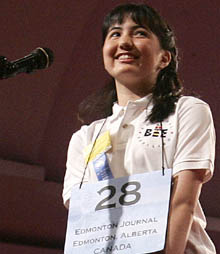
9:20: 13-year old Marissa Lyn Estep and head pronouncer Dr Jacques Bailly take multiple turns clearing their throats and bringing up phlegm attempting a proper pronunciation of the word echt (genuine). It’s the Bee equivalent of watching marathon runners pee on the side of the road – a behavior which under normal circumstances is considered revolting and rude, but within the context of the event nobody is offended. Finally, after pronouncing the word properly, Marissa asks the most obvious question of the day: “Is this word German?”, giving everyone a nice laugh. It’s high comedy at the Scripps Bee, and we’re just getting started.

9:38: There are 14 Canadian spellers in this year’s Bee. This whole Canadian invasion took me by surprise. Apparently we allow any English-speaking kids into our national bee. Do other countries extend this same courtesy to us? How many kids out there have dual spelling bee citizenships? And how come almost all of the foreigners are Canadian – there really weren’t any British kids out there who could make the cut? The Brits are complete language snobs; I’m sure if Eton or Andover knew about this contest, they’d send a whole squad of ringers across the pond.
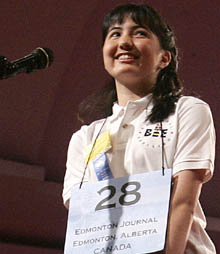
9:40: 14-year-old Finola Hackett from Tofield, Ontario is the two-time Canadian champ, which brings up an intriguing idea: How about rounding up the best spellers from all the English-speaking countries, and having them face off in a World Series of Spelling? These kids are the same age as the gymnasts at the Olympics. I just don’t understand why spelling hasn’t been awarded Olympic status yet.

9:42: 12-year-old Leslie Alix Newcombe from Don Mills, Ontario is the second Canadian speller in Round 5. As she says “zed” at the end of her correct spelling of ersatz (substitute, synthetic), there’s a long pause as the judges glance back and forth at each other. A few seconds later they remember: “zed” is how Canucks say “z”. See, this multinational thing has everybody else screwed up, too.

9:46: Hey – a Big Sur Marathon reference! 11-year-old Anqi Dong of Saskatoon draws the word nepenthe (something capable of relieving grief or suffering). There’s a day spa named Nepenthe in Big Sur, near the point where the buses turn around before dropping runners off. Take that, Boston – I’ll bet the word “Hopkinton” never makes the Bee.

10:20: The bell they use to signal missed words seems a little antiquated. Remember the spelling bee in the old Charlie Brown special called Snoopy Come Home? Whenever a kid missed a word, he or she immediately disappeared off the screen with the sound of a bubble popping. We have the technology to do this for real, don’t we? Imagine how cool it would be if, instead of the bell that signals a misspelling, the kid just vanished from the TV screen. I’m thinking of this as Chris Buchanan misses torrone (a candy made of honey and almonds).

10:34: Nidharsham Anandasivam requests one minute of “bonus time” pondering the word physis (the source of growth or change inherent in nature). Every contestant is entitled to one additional minute if they can’t spell their word in the allotted time – basically, they get one minute for free. You know, if I had one minute of bonus time at this year’s Big Sur Marathon, I would have broken three hours. Not that I’m still thinking about that.

Sometime after 12:00 PM: What? The biggest moment of this year’s Bee is completely missed by ESPN: after they cut away to SportsCenter at the top of the hour, 12-year-old Samir Patel is eliminated from the contest. A 4-time Bee finalist and last year’s runner-up, Samir was the odds-on favorite to win this year. Unfortunately, he couldn’t make it through Round 7, and won’t even appear in the prime time broadcast. (At home that night, I feel the same way I felt watching the Athens Olympics, waiting to see Alan Webb in prime time coverage of the 1500m, only to find out he didn’t even make it out of the qualifying heats. I'm not kidding - missing Samir is just as disappointing.)

Anyway, it’s been a busy morning after 7 rounds, and 13 spellers remain. It’s time for a break. See you in prime-time.

8:00 PM: The moment has finally arrived: Welcome to the first-ever prime time coverage of the National Spelling Bee!

8:01: After an opening montage, the first image from the Ballroom is the 13 remaining spellers huddling in a circle, holding their hands in the middle, then cheering “1-2-3-spell!” Let me put it this way...what if all the competitors in the Olympic 5K final stood at the side of the track, held hands, and cheered “1-2-3-run!” How corny would that look? That’s exactly how this photo-op cheer comes across. Remember what I said about ABC making unnecessary changes? 1 minute into the broadcast, here is Exhibit A.

8:05: Now it’s definitely a big-time event: For its prime time coverage, ABC has replaced Chris McKendry with Robin Roberts. Remember when Robin was a SportsCenter anchor on ESPN? One of her catch phrases was “Go on with your bad self!” Maybe if some kid does the fist-pump-to-chest or does a jersey pull after spelling a word correctly, she’ll use the phrase tonight. Unfortunately, these kids are either too classy or too oblivious to even know what a jersey pull is, let alone to do one at the prime time Bee. What a missed opportunity.

8:07: As the camera pans across the faces of each seated competitor, most of them give a little wave or nervous smile. Not Rajiv Tarigopula. The 13-year-old from St Louis stares down the camera with his best sneer. He’s like Ivan Drago staring down Rocky Balboa and saying, “I must break you.” The broadcasters mention that with the elimination of Samir Patel, Rajiv is now the favorite to win this year’s Bee.

8:45: After Finola correctly spells formenkreis (a species with many subdivisions), Paul Loeffler tells us, “She has the weight of a country riding on her shoulders,” and later in the competition says she “has the attention of her whole nation.” Um, really? Aren’t the Edmonton Oilers in the NHL Finals right now? Are more Canadians concerned with the bee than winning the Stanley Cup? Is Finola more popular than the hockey team in her hometown, which is a suburb of Edmonton? If she wins, will they engrave her name on the championship cup like the Oilers will on Lord Stanley’s? Actually, the trophies look remarkably similar. This is making me nervous. I think I’m pulling for the American kids now.

9:01: The kids seem to be getting an awful lot of French and German words thrown at them in this year’s Bee. Which leads me to wonder: do bees in other countries borrow Americanized words to puzzle their finalists? Are there kids in France or Germany who are memorizing lists with words like crunk, hollaback, and bootylicious? For some reason, that would make me happy if they were – especially after Nidharshan is eliminated by paillon (a thin sheet of metallic foil).

9:24: It’s cool that Finola is doing so well, but here’s the thing: She’s had a remarkable number of French-origin words (guilloche, douane, machicotage, esquisse) in succession to get her through the later rounds. Isn’t French like a second language in Canada? I mean, if I entered a Bee and drew a list of words like anaerobic, fartlek, aquaphor, and Gallowalk, wouldn’t I have pretty good shot at advancing? Although all of these kids are enormously well-prepared, there’s certainly a “luck of the draw” element to this event.

(And I’m not one to suggest a conspiracy at play here, but head pronouncer Jacques Bailly also happens to be of French descent. To recap, that’s a French judge giving French words to a French-speaking contestant. Just thought it merited mentioning.)

9:36: Everyone in the Grand Hyatt Ballroom is stunned. Rajiv can’t nail the correct spelling of heiligenschein (a light around someone’s head caused by diffraction of light), and is out of the competition. Rajiv clearly thought he would win. The broadcasters thought Rajiv would win. Millions of television viewers thought Rajiv would win. Heck, even the other spellers thought he would win. He gets a standing ovation before leaving the stage. But now the most talented competitor who was the clear favorite has been eliminated in the final four…and all of a sudden I’m having these crazy Chris Daughtry flashbacks. You know, it's possible that I've been watching too much TV lately.

9:46: Saryn Hooks misspells icteritious (of a jaundiced color), and we’re down to the final two: Kerry Close and Finola Hackett. USA vs. Canada. This is the matchup everybody wanted in the Olympic hockey tournament four months ago, but never got to see. Now two eighth-graders are left to duke it out for national bragging rights. Hey, kids, no pressure here or anything – it’s just a letdown to your entire country if you lose. Have fun in Round 15.

9:58: During these final rounds, Finola has slowly won over a large percentage of the crowd. Maybe the audience is hoping she’ll be another Tanith Belbin: she’s very pretty, she’s incredibly talented, and if we cheer for her loud enough, maybe she’ll defect to the United States a couple of months before next year’s Bee.

10:04: After sailing through round after round of French words, Finola meets her match in the German weltschmerz (a type of emotional depression). She heads back to her seat with a dejection and dismay. She couldn’t spell the word, but now she’s actively demonstrating it. Unfortunately, the national Charades championship isn’t for another few weeks. On the bright side, I’m positive that the Oilers will honor her between periods at a hockey game this week.

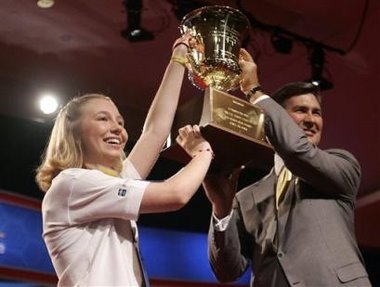
10:08: The audience lets out a collective gasp when Dr Bailly announces the final word ursprache (a parent language). Will German words knock out both of the top spellers? Considering the moment, Kerry Close appears relatively unruffled, and after a few deep breaths, spells the word correctly to claim the championship.
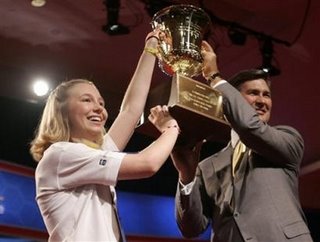

She immediately backs away from the microphone, hands clasped over her mouth in astonishment, and runs off stage to hug her parents. No chest pounding, no jersey pull – just a classy reaction from a gifted girl. She’s a picture of joy as the MC comes over and helps her raise the champion’s cup – the cup that’s staying in America for at least another year.

So tell me: where else but the Bee would international intrigue and nail-biting competition go hand in hand with pre-teen awkwardness and obscure academia? Year after year, the NSB consistently delivers the goods. That's why I'll be watching again next year.

And it's crazy, but usually I get the same kind of weltschmerz after the National Bee that I do after my favorite races, in that I know I have to wait another full year to experience it once again. This time though, I don't feel quite as depressed, because I have my own personal nepenthe: a great new book to help soften the blow.

So now if you'll excuse me, I have some reading I'd like to do.


See other installments of this series on sidebar at right.

Read more...

June 2, 2006

Spelling and Biking (And Walking and Riding)

Wow. So much to say...where to start? I guess I should start by saying that this isn’t my official National Spelling Bee recap post – I need at least the weekend to sort things out in my head and get them down on paper (on Microsoft Word, really...but the phrase “get them down on my computer” just sounds funny). But needless to say I was captivated. Here are a couple of thoughts off the top of my head:

1) Who would have thought that the NSB would develop a subplot as an international showdown? The final standoff felt like watching a gold medal match at the Olympics. The whole Canada angle of this Bee has me spinning…let’s just say I’ll explore this further next week.

2) My preliminary verdict on ABC is that they overproduced the competition. They tried a lot of new wrinkles, most of which weren’t very successful. This is a universal truth that I never comprehend: whenever somebody new takes over something (a new boss, new restaurant ownership, a new coach, etc), they always feel the need to change things just because they have the ability to do so. If something is already successful, most of the changes ineviatbly come off worse than the way things were before. Last night’s telecast was a good example of this. But thankfully they didn’t go completely overboard with it.

3) If the legions of home-schoolers were hoping to dispel the perception of home-school kids as quirky intellectuals with enormously overstuffed bookshelves in their house, who enjoy reading dictionaries and encyclopedias when they aren’t playing video games, well…last night’s telecast may have been a minor setback.

I’m stopping there for now. Trust me, there’s more to come next week. In the meantime, I was going to write more about the Dipsea today, but then I went on this bike ride yesterday, and I think it’s a more compelling story.

I was scheduled to work about 12 hours yesterday, so I figured I’d take a quick spin on my bike for about an hour at midday.

I made a beeline out of Salinas through the campos for about 25 minutes. Salinas is a fairly small town, and if you head directly through the fields, you come upon vast open stretches where development stops and very few cars travel and where the natural landscape provides overwhelming solitude.

It was in just such an area that my bike chain broke.

It didn’t just come derailed or unsnapped – it tore apart in about three places. The simple chain tool I had with me wasn’t adequate to fix it. It was beyond repair.

For dramatic effect, this might be a good time to mention that I don’t own a cell phone.

Essentially I was stranded, many miles from civilization. Every time I get on a bike, this is my single greatest fear. And now it was happening for real.

I kick-push-coasted on my bike for about two miles to an intersection of two county roads, then walked for another half mile pushing my bike with one hand, holding my chain in the other, holding my arm out to hitch a ride.

Eventually a girl with a bike rack offered to give me a ride, but she wasn’t going to Salinas. She took me as far as a gas station in the nearby town of Seaside, where I used the payphone to call a cab.

Two hours, one humiliating cab ride (Do all cabbies feel the need to blather endlessly, regardless of whether the person in the back is responding? Do they learn this in cabbie school? This was unquestionably the most uncomfortable part of my day), and 40 dollars later, I was back at work. Once I add the cost of buying a new chain and repair tool, it will turn out to be a very expensive bike ride.

I love cycling. I really do. But yesterday was a perfect example of why running will always be my full-time pursuit. I know situations like this aren’t a common occurrence, but just the thought that the possibility exists with every ride is enough to stress me out at times.

I mean, would anything like this ever happen if I was running? The only similar thing I can imagine is if I were deep in the forest somewhere and happened to break a leg bone, eventually signaling a search and rescue group to bail me out. But even then, I’ll bet the search and rescue guys wouldn’t drive me nearly as crazy as 20 minutes with that cab driver did.

Anyway, I made it back and finished work and despite the expense, things pretty much turned out fine. I’ll probably even get a new chain for my bike and try another ride soon.

But I might need to reconsider my cell phone situation.

Read more...

June 1, 2006

Running and Spelling

(Actually, if taken in order, it would be “spelling and running”…)

Part 1: Spelling

It’s Thursday afternoon, and I’m at work. And not watching the preliminary rounds of the National Spelling Bee. Apparently, watching the Bee doesn’t justify taking a whole day off to some of the senior management and administrative personnel I work with. Whatever. Some people just don’t get it. Thank God for TiVo.

I’m also distressed about the technological apathy in multimedia coverage of this event. I mean, we can land a rover on Mars that sends photographs to Earth, and we can film the migration of animals from space satellites, but we can’t watch streaming video of the Bee on our laptops at work? Isn’t technology supposed to improve our quality of life? What’s more agonizing than knowing the capacity exists to do something, but nobody cares enough to implement it? I swear, that Bee should hire me as a PR consultant one of these years.

I’ll watch the coverage on TV tonight, of course. I’m interested to see what ABC does with it. I’m excited to see how the competition unfolds. I’m curious to see if anyone passes out. In this competition, nothing surprises me anymore.

But since I’ll have 3 hours of prelims to watch before the main event, and since we’re getting the West Coast feed, the event will be long since over before I learn who wins. That’s why our house is going into an electronic cone of silence tonight - I’m not looking at e-mails or the Internet, and not answering the phone. You think I’m exaggerating, but I take this thing seriously. Tonight could be a very late one, like when the CNN anchors stay up past midnight to announce election results. Only in this case, it’s for something really meaningful.


Part 2: Running

This morning I hit the track again, in yet another attempt to transform myself from a Clydesdale into a thoroughbred in a short time span. I go through this process every year, and it never works well.

There are usually only 6 weeks between the Big Sur Marathon and the Dipsea Race, which happen to be my two favorite races. Six weeks may seem like a long time, but when you factor in one rest week after the marathon, and another week of fatigued running, it doesn’t leave a whole lot of time for quality training.

The Dipsea is an intense race. It requires prolonged anaerobic efforts on the steep climbs, bursts of explosive speed to pass people, and high-end footspeed to make up ground on those who start ahead of you. In other words, you need to race like a thoroughbred. The best way to train for it is to mimic these conditions with sprint workouts and high-intensity hill repeats built up gradually over a long period of time.

Unfortunately, I spend the beginning of January through the end of April logging high mileage, long-duration workouts in my marathon buildup. I’m very careful not to overdo the speed work in fear of injury. Like a Clydesdale, my top end speed is never great, but I can sustain my “pretty fast” speed for a long period of time – which is exactly what you want for a marathon. The training gets me in great shape to race 26.2, but inappropriately prepared for the challenge of the Dipsea.

So when the calendar turns to May I start doing shorter, faster speed work sessions, and racing up the steepest hills I can find. These workouts are always a shock to my system, and I’ve often made the mistake of trying to progress too quickly. Many years I’ve arrived at the Dipsea with a muscle pull or minor injury because of my short-cycle training approach – and I end up racing worse than if I hadn’t done any sprint workouts at all.

So far this year, I’ve been doing OK. The track workouts have been intense, but maybe just one notch lower than what I typically do in May and June. I’m sore but not injured. And my speed is slowly coming around. If I can avoid screwing things up for a week and a half, I should be in halfway decent race condition.

But I don’t have any lofty ambitions for myself next weekend – as I’ll describe more in my next post.

(You know, after I come out of the cone of silence...)

Read more...

May 30, 2006

The Dipsea Race

OK, I've done a lot of rambling about totally random stuff lately, so for this post I'm sticking 100% to running, in an effort to equalize things a bit. Well, let's make that 99% running...have I mentioned that there's a spelling bee this week? Less than 48 hours away now. Just thought I'd remind you. Now on with the post...

Every year on the second Sunday in June, the world-famous Dipsea 7.1M trail race (see race schedule link at right) is run through the hills of Marin County, from Mill Valley to Stinson Beach.

Each of the last 8 years, I’ve been there, too. And in less than two weeks, I’ll be there again.

The Dipsea is truly a legendary race, held in almost religious regard amongst Bay Area trail runners. It is the second oldest footrace in the country (behind only the Boston Marathon), and this June will mark the 96th running. The motto of the Dipsea is “The Greatest Race”, and it is definitely the most exciting event most people will ever run.

This race is not for the faint of heart. Although only slightly longer than a 10K, more than 75% of the race is on challenging single-track trail or fire roads. The course profile is simple: climb 650 feet, immediately descend 500’, climb another 1360’, then race downhill through the forest until you reach sea level at the beach.

It all starts in the picturesque town square of Mill Valley, but immediately turns nasty as runners ascend 670 stairs, the height equivalent of a fifty-story building, in order to reach the start of the trail. They cross Panoramic Highway, descend into Muir Woods National Monument, then start the second climb up and over Mount Tamalpais. The long final downhill includes railroad-tie stairs, river crossings, and jumping over an unmarked fencepost about ½ mile from the finish.

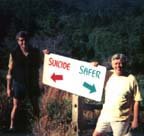
Different stretches of the course have distinctively intimidating names such as Cardiac, Steep Ravine, The Swoop, Insult Hill, and Dynamite. The most ominous name of all comes relatively early in the race. At a fork in the trail about 1.75 miles into the race, a sign is posted: one arrow on the sign points to a trail marked “Suicide”, and the other arrow says “safer”. As the race brochure will tell you, Suicide is the traditional racer’s route.

The trail becomes crowded in many places, and hot weather causes dusty conditions which limit visibility and make footing very treacherous. Passing becomes dangerous on the long narrow stretches, especially if a competitor doesn’t want to cede the trail. In these situations, the race turns into a full-contact sport, and it’s not unusual to see people knocked to the ground. A good deal of time is also spent jumping over fallen runners who have tripped on precarious roots and rocks, or slipped on the steep slopes. Some runners even start the race wearing protective equipment that may become necessary deep in the forest.

The race is unique for several reasons. Foremost is its handicap-start system, which gives head start minutes based on gender and age. Thus, the oldest women and youngest kids leave first. Each minute thereafter, the other runners leave in groups according to their assigned handicap. By the time the 20- to 30-year-old men leave, the first runners have more than a 20-minute head start.

The handicap system streamlines the amount of runners on the single-track at any one time. It also means that younger, faster runners are constantly passing all those who started ahead of them. (For a sense of what this looks like, check out this photo of me from last year's race. For this one hour each year, I feel absloutely no shame about barging past old men or young girls as I'm storming through the trail. Don't hate the player, hate the game.)

The first person to cross the finish line wins, and the only thing that matters is overall place; no age group or gender awards are given. The assigned handicap times are adjusted periodically to make the race more competitive. Typically the first five finishers include a combination of high-school runners, top 50- or 60-year-old age-groupers, or extremely fast open runners.

If you finish in the top 100 your place will be on your bib number the following year. The first 35 finishers are awarded a black shirt numbered with their overall finishing place. These shirts are coveted status symbols in Marin County, and are the most prized possession of any runner’s collection- far more valuable than any PR or age group award.

Another unique aspect of the race is the “open course” system. Basically, once you leave Mill Valley, you’re free to take any shortcuts through the forest that you know about. This provides a huge potential advantage to Marin County runners who frequently train on the Dipsea trail and explore various options to shave a few seconds wherever possible.

There are several places where the trail splits into branches, which reconnect at a later point. There is strategy involved with taking a longer, wider route instead of a more direct single-track which may be crowded.

The consensus “best route” is marked, but racers are always dashing off through the woods at unmarked areas. It’s risky to follow someone off the course, because there’s no positive way of knowing if a “shortcut” is actually a faster route, and you both may end up getting lost or injured.

The race started as a 2-person contest in 1904, then grew into an invitational event, and eventually became open to the public. Entry into the race is somewhat complicated and intentionally favors Marin County runners. In order to limit damage to the trail, the race is limited to less than 1500 runners, although about 4000 apply. However, with persistence (and a good bribe- I’m not kidding), it is possible to obtain an entry.

I love this race and fear it in almost equal amounts. Through the years, it has come to occupy a special place in my heart. The Dipsea will be on my mind a lot over the next two weeks, and I’ll write a couple more posts about it as race day approaches.

Read more...

May 26, 2006

Great Moments in Spelling: The Interview

We’re now less than one week away from the National Spelling Bee. If you’re like me, you’re feeling the electricity in the air in anticipation of the event. And if you’re not like me...well just humor me over the next several days and pretend like you’re interested. Because things might only get weirder from here.

Have you ever met somebody and wondered how your paths didn’t cross years sooner? I found someone like that a few months ago, who will be my co-blogger over the course of several posts related to the NSB.

Through a mutual acquaintance, I have been exchanging e-mails with a man named Dave Riddle, who lives in Pacific Grove and was the National Senior Spelling Bee champion in 2005. His son Christoph represented Monterey County in the NSB on 2004. They were 50 feet away from the famous Akshay Buddiga faint, a moment that will go down in Bee history in similar fashion as Wilt Chamberlain’s 100-point game for basketball or Game 6 of the 1986 Mets/Red Sox World Series for baseball.

It also happens that Dave is an awesome runner. His PRs in every event just smoke any of the best times I’ve ever run. For all these years, I thought I was the only guy who dreamed of an Olympic running/spelling duathlon, but it turns out I wouldn’t even have a chance of making the team – this guy would leave me in the dust in both disciplines.

When I heard that there was a fast local runner who also happened to be a National Senior Spelling Bee champ, who also had a kid who participated in the NSB...I mean, I wouldn’t have been any more excited if you told me Beyonce had moved in down the street and was looking for a running partner. I figured this was a guy I had to talk to.

After we touched base, I blindsided him with a crazy proposition: I wanted to interview him, and by extension his son, about the spelling bees. I wanted to see how the preparation and competition affected a person and his family, and compare it to what athletes experience in their particular events. And I wanted to post the interview on my blog.

Amazingly, he agreed. And then my head started spinning. The problem wasn’t coming up with questions, but limiting the amount and scope of things I asked so my interest in him didn’t cross the line from “curious inquiry” to “disturbing fetish”. I eventually settled on a list of questions, and fired them away.

So Dave doesn’t have to answer all the questions at once, I’m going to post the interview in sections, starting with Part 1 today. Part 2 will be whenever we get around to putting it together, and so on.

Here, then is Part 1 of what I think will be a very interesting series. It discusses family commitment, overcoming setbacks, and triumph through perseverence and endurance. If you’ve stuck with me this far through this post, the interview is definitely worth another few minutes:

***

Q: First, give me some of your running credentials. How many years have you been running? How much running (miles per week, or workouts per week, etc) do you do currently? What are your favorite races? What are your best times? Any other info you want to give me would be fine.

A: 5K 15:50 Stuttgart (1984); 10K 32:50 Frankfurt (1984); 10 mile 55:47 San Diego (1976) ½ marathon 1:12:57 Korea (1982); marathon 2:33 Long Island (1982). I had been running and competing in earnest since 1965 and quit in 2003 with the Bubba Gump 5K. I wanted to end on a high note by winning the division (50-55) and breaking the 6-minute pace. While no stunning achievement, I was happy to do both. I’m free to not run now and stay fit anyway. Tennis is my overwhelmingly favorite sport.

OK, on to the spelling questions…

Q: First of all, congratulations to both you and your son on your amazing accomplishments. There probably aren’t too many parent-and-child teams who have individually competed in national championship competitions. How did you each get involved in the competitions? Did one of you start, and the other join in later, or has it always been a family thing to train for spelling bees? Do you train together? Does the rest of the family get involved, too?

A: The father-son spelling thing began in 1999. My son, Christoph, was doing spell-offs in the 4th grade to qualify for the annual Lyceum bees for 4th and 5th graders. The same year, the Friends of the Pacific Grove Library announced it was putting on the 1st annual adult spelling bee as a "Butterfly Town" fundraiser. My son and my team each did well in our respective events---but won no honors.

Over the next few years we did better. In the 5th grade Christoph was the school’s alternate for the Lyceum Bee. I began poring over obtuse spelling word lists, definitions, and etymologies. This learning experience enabled me to gradually bolster Christoph’s chances of succeeding in the one bee that counted: Monterey County.

He really wanted to go to DC. I was motivated to right that 1st year’s “loss” at the Pacific Grove Adult Bee and set an example for Christoph. I organized adult teams that won 3 years straight. My family always sat at our table as supporters.

As parents know, the pressure is immense if your child hasn't achieved what he/she would like to achieve--e.g., place in or win school, county, regional, national competitions--whatever it is. It’s tough on the parent, too. My son, Christoph, tried and tried, leading up to his third and final attempt to qualify for the NSB by winning our Monterey County Bee in 2004.

It was his last-chance effort, and he knew he was the underdog. The girl who had been second in the previous two county championships (and who won the Lyceum bee) was back again for her last try too. The Monterey Herald article is below. [Editor's note: long-time running bloggers will recognize the name on the Herald by-line.]


HAVING THE LAST WORD
After 5th place in 2003, teen wins spelling contest

By JONATHAN SEGAL

In a 29-round rumble rivaling any prize fight, York School's Christoph Riddle took down Carmel Middle School's Stacy Little on Sunday to win the 2004 Countywide Spelling Bee.

Call it the Fracas in Salinas.

Stacy had finished second two years in a row. Christoph was looking to top last year's fifth-place finish.

Their 49 other opponents vanquished by Round 8, Stacy and Christoph, both eighth-graders and seasoned spelling-bee veterans, sparred for 21 more rounds. They traded spellings on words that could make even the most stout-hearted librarian break out in a cold sweat.

They spelled words like diaphaneity -- the quality of being translucent -- or eurybathic -- capable of living underwater in a wide range of depths.

Several times, one child or the other would get a word wrong, opening an opportunity for one to become a victor. But each time, the other child would spell their word wrong, too.

Each time, that is, until round 29, when Stacy met up with acervation, a noun meaning an accumulation. She misspelled it by inserting an "S."

Christoph sashayed to the podium, correctly spelling cachexia, which is the wasting away caused by a chronic disease, and, finally, patache, which is a smaller ship that tends to a fleet.

And Riddle beat Little. He's headed to Washington, D.C. to compete in the Scripps-Howard National Spelling Bee. How does it feel?

"Pretty damn good," said Christoph. "I would have been happy with second."

Christoph's victory was a team effort, said his father, Dave Riddle, a government lawyer at the Presidio of Monterey. But in the end, the father had to watch from the audience at Hartnell College. Dave said he felt like he was exploding as he watched his son from the stands.

"It was a family thing we were doing," the elder Riddle said.

The analogous sports term would be “upset.” You can bet we have a laminated copy of the article at home with its color photos.

***

OK, that's enough for Part 1. Michelle has probably had to refill her tea twice by now. More to come later. Have a good weekend everybody.

Read more...

May 25, 2006

Signature Songs

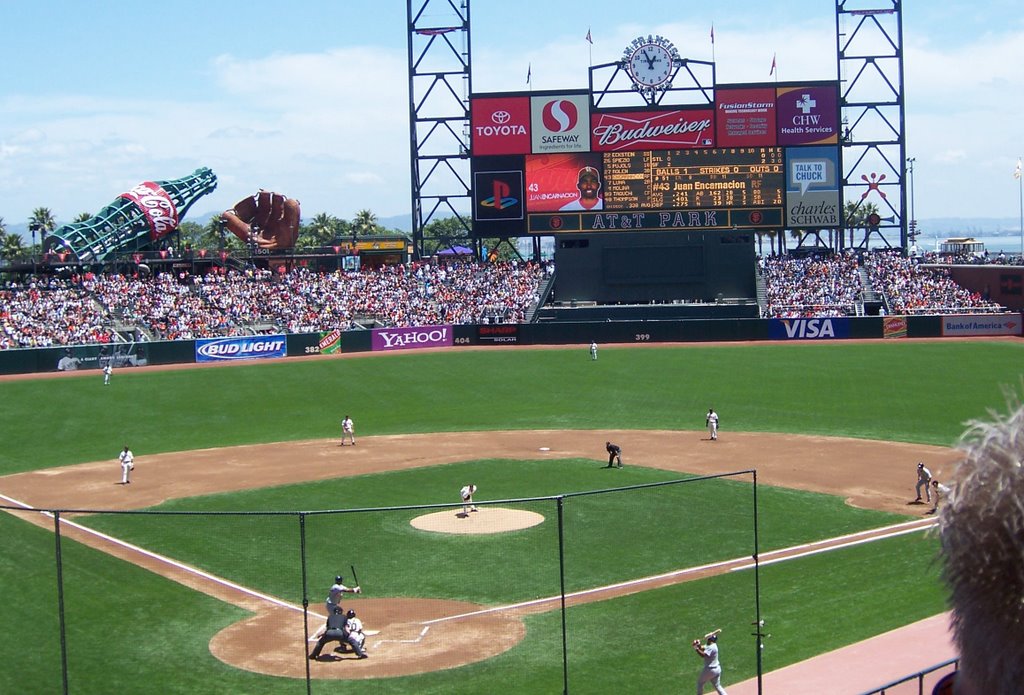
Instead of staring at my cubicle and laptop yesterday, this is what I spent most of the day looking at:


Cardinals at Giants, AT&T Park in San Francisco, on a beautiful 70 degree day. Afternoons don’t get much better than this.

I have this on again/off again fascination with baseball, which is currently in the “on” phase. It’s such a simple game in its fundamentals: you throw the ball, you catch the ball, you hit the ball, etc. Yet the more you study or practice it, you see the rich complexity in considerations and calculations that take place at any given moment, with every pitch.

An activity that looks simple, but has inner complexity. Hmmm…sound familiar?

Actually, I’m keeping the running portion of this post relatively minor. There are a few other items I want to touch on beforehand:

1) Good dad/bad dad: It occurred to me when I posted yesterday that some people might wonder whether my son was supposed to be in school. Yes, he was. So was I a cool dad for taking him to a ball game, or a bad role model for escorting him on his own Ferris Bueller day?

Here was my rationale: if he weren’t a good student, didn’t take school seriously, or had missed several days already, I probably would have waited until his summer break. But he is, he does, and he hasn’t, so I felt OK about it. I think some experiences like this are more valuable than a day in the classroom.

(And just for good measure, my wife had him do a full day’s worth of schoolwork in the evenings before the day he missed. At least the kid has one responsible parent.)

2) Barry Bonds: He didn’t play. We were glad. When we picked this date on the calendar six weeks ago, we thought it would be a great day to go when the stadium wouldn’t be too crowded. Then the whole Bonds/Babe Ruth situation reached a crescendo, and we were looking at the possibility of being there on a historic day.

I wasn’t looking for historic. I was looking for mellow. Plus, I dislike Bonds in too many ways to discuss here. So I may have been the only person at AT&T Park who was happy he wasn’t playing.

3) Gilroy fries: It’s impossible to walk around the stadium without smelling the Gilroy garlic fries that are served throughout the park. Gilroy fries have become San Francisco’s equivalent of Dodger Dogs. I’m a garlic fanatic, so I knew there was no way I could pass these up (Angie and Olga, maybe you better not look):


Yes, they were as greasy as they appear. And they were absolutely delicious. And they may or may not have explained the following exchange when I returned home:

Me: (walking over to wife): Hi sweetie, we’re home. (leaning over to kiss her)

Wife: (pulling away, making a face) Wow...you stink. Go take a shower.

(Ah, marriage...it gives you such a soft place to fall at the end of the day.)

4) Intro songs: Here’s the part that had me thinking about runners. Each player has his own song played when they come up to bat. Usually it’s just a 10-second snippet, but it’s the same song each time. Same thing for the relief pitchers – when they are warming up on the mound, the PA system blasts their “signature song”.

A lot of the players chose rock/metal tunes. One Giants reliever selected “Mother” by Danzig. Some of the batters had Metallica, AC/DC, and Rush.

It got me to wonder: if I could pick a signature song, what would it be? If I could choose a song when I’m warming up for a road race, or if I was ever introduced at a track meet, what song would I select?

I’ve never really had a “favorite” song, but here’s the short list I came up with:

1) Lose Yourself, by Eninem. A song about rising to the occasion for a major event. Pretty self-explanatory.
2) Best of You, by the Foo Fighters. This is a bit confusing. I think the lyrics are intended to be about being abused, but I always hear the chorus question “Is someone getting the best of you?” as a self-analysis, asking myself if I’m doing the best job I can at something. Like I’m reminded to give the best of myself to what I’m doing. Am I wrong in this interpretation?
3) Higher Ground, by the Red Hot Chili Peppers. Kickin’ it old school here. If there were just a 10-second snippet, the lyric “I’m gonna keep on trying, ‘til I reach my highest ground” set over a funky bass line is a tough one to beat.

The most likely scenario, I concluded, was that I would be one of those neurotic players who drive the PA people insane by asking them to change my song every week. Maybe it’s a good thing we don’t do this in running.

Anyway, that was my day, and those are my song choices. What would your song be?

Read more...
Related Posts with Thumbnails

  © Blogger template The Professional Template by Ourblogtemplates.com 2008

Back to TOP