June 12, 2006

Dipsea By The Numbers

If you’ve learned anything about the Dipsea race from my previous posts, it’s that numbers are the only thing that matter. Not the clock time, not your age group place, but overall finishing place.

Accordingly, my race report from the 2006 Dipsea will be strictly by the numbers:

96: Number of times, including Sunday, the Dipsea has been run. It’s confusing, because last year was the 100th anniversary. But like the Boston Marathon and so many other sporting events, the Dipsea went on hiatus during the World War years. Could any of us imagine something like that happening today – the whole baseball season being called off, or the most popular recreational sporting events suspended for several years at a time? There’s a war going on right now, isn’t there? For various reasons, we don’t make nearly the sacrifices our forbearers did in supporting our war efforts. In the grand scheme of things, that’s probably not a good thing.

(Sorry, I didn’t mean to turn this into “Meet the Press.” Back to the running…)

9: Rank, out of nine, of this year’s shirt color in comparison to all the other years I’ve run here. The Dipsea changes shirt colors each year –
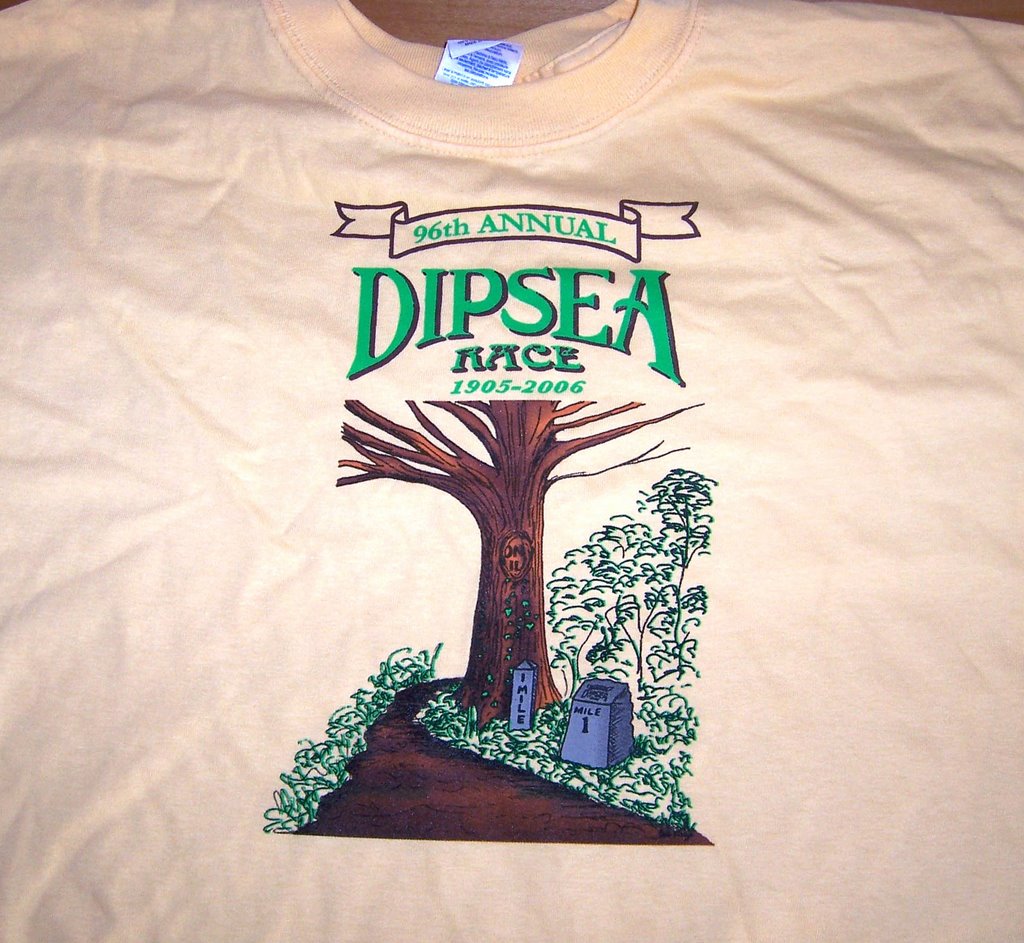
usually it’s a sharp blue or green or cream color. But this year’s strange yellow hue is undoubtedly the worst. There’s nothing that says “This is a tough race” quite like the color of, um...butter? Dandelions? Lemon zest? I’m just not seeing it.

On the other hand, maybe that’s just a guy thought – because my wife and 5-year-old daughter both commented on what a nice color shirt it was, without even being asked.

22: Number of head start minutes the first runners had before I started the race. There are a lot of ways this race kicks you in the teeth, but I’ll say this: there's no other race that rewards getting older quite so generously.

1: Number of head start minutes I receive. Apparently in the eyes of the Dipsea committee, I’m not very old yet.

3: Number of years I have to wait until I get another head start minute. You know, patience has never been one of my better qualities. I’m not sure how I’m going to get myself through the next 1094 days. Not that I’m counting.

8: Bib number on the guy next to me on the start line, meaning he came in 8th place last year. I exercised some prudence and took a couple of steps backwards so I wouldn’t feel so discouraged when he left me in the dust. It was a humble, but smart move.

2: Minutes at the beginning of the race where I felt completely terrified. I’ve already called this race intimidating, but that doesn’t really do justice to the feeling of dread I have every year when taking off from the start – knowing the pain that lies ahead, and knowing that if I take the easy way out and run conservatively, I’ll feel like a failure. I get so anxious during the first quarter mile that I almost feel like throwing up. Thankfully, after I hit the stairs, I’m usually able to find a rhythm and settle down a bit. But those first two minutes are always horribly gut-wrenching. I can’t overemphasize this.

677: Number of stairs climbed in the first mile of the race. There’s no better way to describe these stairs than as absolute quad killers. The Dipsea stairs are the signature challenge of this race, but after several decades of use, many of them have fallen into disrepair. So this year the race committee started a fundraising drive to reconstruct portions of the stairs, to ensure that they inflict the same misery on generations of Dipsea runners to come.

1000: Number of dollars required to “sponsor” one of the new stairs. A plaque engraved with your name will be mounted on one of the Dipsea stairs for everybody to see. But here’s the thing: these stairs already own me. Every year on the second Sunday in June, I become their bitch. So placing my name on one of them would seemingly send the same message as a girl having her boyfriend’s name tattooed on the top of her ass. It’s not exactly something I would want to be made public. But maybe that’s just me.

4: Number of kids knocked over by me during my 7.1 mile romp to Stinson Beach. For the record, two of them jumped in front of me unexpectedly when I was passing them, so they had what was coming to them. Although they all lost their footing, none of the kids actually hit the ground, at least from what I could tell. I’m sure they’ll be fine. I prefer to think of the whole situation as me helping them build character. Because that's me: I’m all about the kids.

11: Age of the girl I found myself sprinting against during the final 200 meters. With about 100 meters to go, I was finally able to drop the hammer on her, and I didn't feel the least bit of shame in dropping her. Don't feel bad for the girl, though - at least I didn't have to knock her down to move past her.

90: Minutes my friend Mike drove to see me at the finish line. He and his wife were staying in San Francisco for the weekend, and decided to come see the race I keep badgering him about. It was great to see him. I typically run this race by myself and don’t know anybody at the finish area, so it felt nice to see a friendly face.

Despite my constant pleading, Mike doesn’t have any interest in doing the Dipsea. In fact, seeing countless finishers cross the line muddy, limping and bloodied probably sealed the deal for him. But he came to see me anyway. Now that’s a friend.

Mike also took this picture of me at the finish:
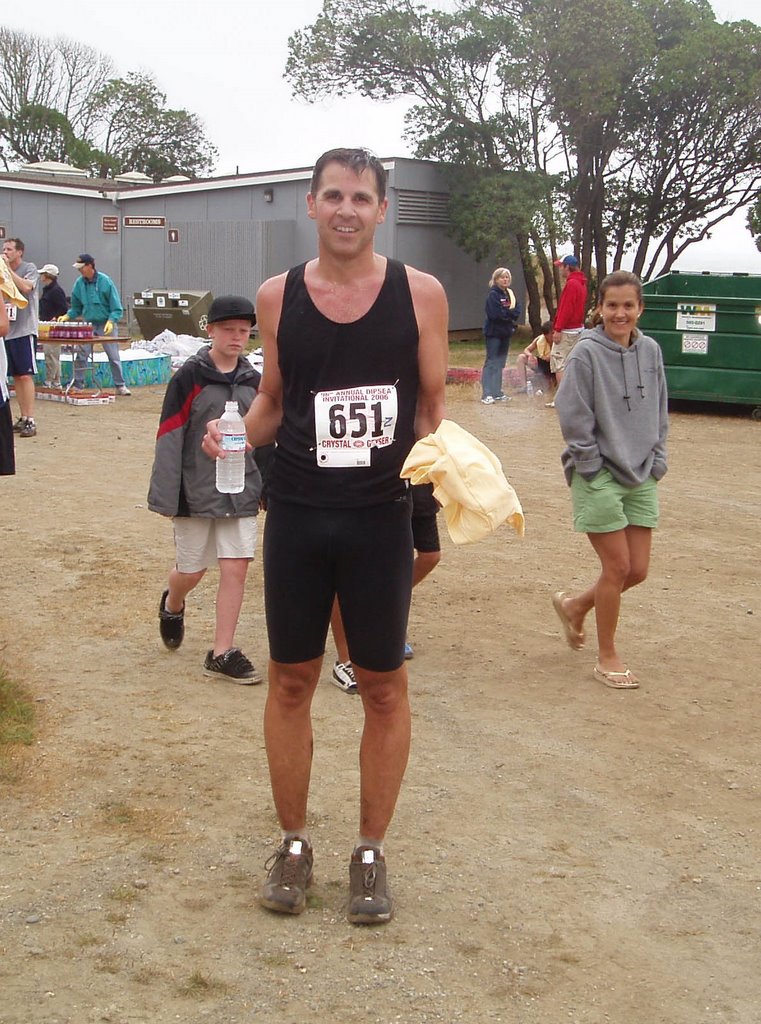

Don’t I look happy? And, um...is that girl in the back laughing at me? She knows I just ran a race, right?

62: Age of oldest man to run faster than me. Last year there was a 68-year-old who beat me, so I appear to be closing the gap on the sexagenarian men. As for the women...

52: Age of the oldest woman to beat me. Remember the 51-year-old woman I wrote about who thrashed me last year? She was back again. I'm not making any progress here.

Actually, I shouldn’t even be writing about this age thing. It’s such a no-win situation. Even if I get faster over the next few years and catch up to some of these 50- and 60-year-olds, I’ll still get myself all tied up in knots worried about...

14: Age of youngest male and female runners to beat me. A girl ran the course two minutes faster, and a boy ran five minutes faster than me. Like I said before, this race attracts some amazing runners on both ends of the age spectrum.

10: Minutes between phone calls to my wife (at home in Carmel Valley) from Mike’s cell phone as he drove me back to the start line after the race. The cell phone got poor reception amidst the tall redwoods and frequently cut out on us. Which wouldn’t have been so bad, except that Mike decided to start the conversation with a joke:

My wife: Hello?

Mike: Hey, it’s Mike. Your husband’s in the car with me. He’s lying in the back seat, bleeding and almost passed out.

My wife: What? Really?


And that’s when the cell phone reception died.

6: Baskets of fresh strawberries, along with one box of cherries, that I purchased from a roadside produce stand in Gilroy on my way home. Have I mentioned before that I like strawberries? For some reason I think I’ve mentioned that already. Needless to say, it was the highlight of my commute back to Monterey County.

25: Approximate number in the batch of cherry chocolate chunk cookies, baked by my wife, that awaited me when I returned home. I’m fairly sure she had made them even before she thought I might be dying. My wife is pretty much a saint in the things she does for me and the nonsense she puts up with on a daily basis. It’s occurred to me lately that I probably don’t say that enough.

And now for the really important numbers…

64: Minutes it took me to do the race. This is almost four minutes faster than last year, and only about 80 seconds slower than my best time here. I was able to maintain a strong effort throughout the race, and I’m happy with the improvement.

17: My relative standing in my starting group, out of 60. In a way, the blogging I did last week helped me in this regard: it forced me to realize that I wasn’t going to be at the front of the group. Therefore, I didn’t feel any pressure to stay with the guys who went off the front. That enabled me to start more conservatively and avoid hitting a lactic acid wall in the middle of the race. Remember what I said last week about humility being a good thing? I was pretty much just making that up because it sounded good. But in this case, it turns out I was actually right. Go figure.

218: My overall finishing place. This is about 150 places better than last year, and pretty close to my best-case scenario of under 200. Honestly, I had been somewhat concerned about my downward drift through the standings in recent years. This year’s race gave me some encouragement that someday I can compete with this crowd. Don’t misunderstand: I still got my annual whuppin', but I’m generally satisfied with my performance.

All of which means that after today, I’m still on track for…

14: Number of years to go on my 15-year plan to reach the top 100 in this race.

I'm determined to do it. No matter how many little kids I need to knock over to get there.

Read more...

June 9, 2006

Dipsea Runners Anonymous

“The more you suffer, the more it shows you really care….right?”
- The Offspring, "Self-Esteem"


For those who haven’t been following my Dipsea posts lately, allow me to briefly summarize the main themes I've touched upon:

• The Dipsea Race is completely hardcore. It’s the most intense, most dangerous, and most painful race I do each year.
• Because of it’s proximity to the Big Sur Marathon, I never train for the Dipsea as adequately or appropriately as I should.
• I get kicked around by so many people up there that I come home with my tail between my legs every year, yet...
• I absolutely love it.

Makes perfect sense, right? Do I sound like an addict? Do they make 12-step programs for people who are in abusive relationships with races? My name is Donald, and I’m a Dipsea runner.

Actually, I like the sound of that. It's the kind of addicition from which I don't want a cure.

And on Sunday morning, I'll gladly give myself another dose.

Read more...

June 8, 2006

Where Everybody Knows Your Number

I’ve alluded a couple of times to the only Dipsea Race results that matter: overall finishing place. It’s a unique aspect of the race, and a noble attempt at meritocracy. In a perfect scenario, assuming everyone receives the appropriate head start minutes for their age and gender, then the people who cross the finish line first are truly the most accomplished runners in the field.

In reality, however, there are a lot of bugs in the system.

For the past eight years, only three people have won the race: Russ Kiernan (who is 68 this year), Shirley Matson (65) and Melody Anne Schultz (64). The very best open and high school-aged runners are very lucky to crack the top ten.

Head start minutes are adjusted periodically based on past results, but every year there is a lot of whispering at the Dipsea that the head starts give an insurmountable advantage to older runners. On the other hand, it’s tough to establish a legitimate age-graded handicap when you’re dealing with three of the best senior runners in America. It’s one of those enduring, never-to-be-resolved arguments that make the race interesting.

I really don’t worry about what goes on at the top of the lists. I do, however, pay attention to my overall finishing place. In this regard, there are four milestones that every Dipsea runner can recite by heart:

750: The place that “qualifying” runners need to beat to qualify for the following year’s race. This is complicated, so pay attention: every year, immediately after the official (called “invitational”) race, there is a second wave of runners who do the race – with the same handicap starts – to qualify for the invitational race the following year. If they finish in the top 750 overall (including invitational race participants), they automatically qualify. Essentially, it’s a rookie race, and it’s the standard method of entry to the main event.

450: The place that invitational runners need to beat to automatically qualify for the race the following year. In some cases, this is literally the line of no return; because entry to the race is so competitive, if you fail to hold your spot for one year, there’s a good chance you won’t be selected again the following year.

100: Beat this place, and you get your place on your bib number the following year. There’s a totally intimidating vibe when you’re standing next to someone in your group wearing the number “20” – and from my perspective, even “99” is pretty astounding. A few years ago, this was a short-term goal of mine, but not anymore (as I’ll explain shortly).

35: Beat this place and you’re awarded one of the coveted black shirts numbered with your finishing place. If I’m in the Bay Area during the summer or fall I’ll occasionally see someone wearing one of these shirts, and it’s like seeing someone wearing a Super Bowl or World Series ring. You just know that person is a Top Gun trail runner: the best of the best. I'm not kidding - it’s that impressive.

Where do I fit in? As I indicated yesterday, I’m right in the middle of the pack. However - perhaps naively - I have hopes of moving higher.

In my rookie year, I was faster than 750th. I don’t remember exactly what place, but it didn’t matter: I was eligible for the main event for the following year.

In my first three years of the invitational race, I finished in the mid-200s. When I finally got one head start minute three years ago, I improved to 180th. At that time, I figured I would gradually narrow the gap to the top 100.

That never happened. Each of the past two years, I’ve been some combination of injured and overfatigued, and I ran the race a few minutes slower than usual. After last year’s race, I wasn’t certain that I had even made the 450 cutoff until I checked the web results the next day. I made it, but in 374th place - by far my worst showing at this race.

For male runners in their thirties, advantages are very slow in progressing. I won’t get another head start minute for another few years. So while I'm not looking for dramatic short-term improvements, I have a long-range plan for this race in the years to come.

I honestly doubt that a top-35 finish will ever be within my grasp. Unless I have a dramatic transformation in my training and race performances and also manage to stay consistent as I get older, I just don’t ever see myself wearing a black Dipsea jersey. I suppose stranger things have happened, but I’d truly be astonished.

More realistically, I’d love to finish in the top 100 some day. But it will be quite a long haul to get there.

I’m hoping to have a solid race this year and get back near 200th place – maybe even lower if I have a great day. Once I pick up another head start minute, I’d like to start climbing my way up the ladder toward the top 100. I’ll probably need at least 10 years, or maybe even (for you, Stronger) a 15-year plan for reaching that milestone.

But you know what? I like the idea of having some incredibly long-range goals. I recognize that there’s no guarantee that I’ll even run another week, let alone 15 more years. But I know that for every week and month and year that I’m able to run, this race will continually give me a lofty goal for which to strive.

And if you’re still reading my blog in the year 2021, I’ll keep you posted on every step of the journey.

Read more...

June 7, 2006

Dipsea Syndrome

Sometimes I think of myself as a fast runner.

The Monterey Peninsula is a fairly small area, and I train with a group of the fastest local runners. In any hometown 5K or 10K race, I can often run fast enough to win an age group award. When I have a solid effort in the Big Sur Marathon, I’ll typically finish in the top 30 or 40 runners overall. With Big Sur at the end of April, after a good race I’ll sometimes spend the month of May thinking that as runners go, I’m not half bad.

Then I travel to the Dipsea Race every June, and come away completely humbled.

The Dipsea is where I go to get my annual whuppin’. It attracts the fastest runners in the Bay Area, many of whom happen to be the best masters and senior runners in America. When I pore through each year's race results, two very powerful lessons emerge:

1) There are an awful lot of very fast runners out there, and
2) I’m not one of them.

I’ve described how the Dipsea employs a handicap start, giving head start minutes to certain runners based on age and gender. I currently start near the tail end of the group. When I first ran this race – before the age of instant Internet-posted race results - I thought that my middle-of-the-pack finishes were due to the head start system. I usually left Marin County believing that from a talent standpoint, I fit right in with the crowd, and as I got older my overall place would start to climb.

But in recent years, when I took the time to look over the results, I discovered that I wasn’t nearly as accomplished as I thought I was. Here in Monterey County I’m a relatively big fish – but compared to the talent in the Bay Area, I’m just a lot of people’s bucket of chum.

There are some simply amazing runners who show up at the Dipsea each year. Even if head start minutes are factored out, my time last year was only the 203rd fastest overall. Russ Kiernan, the 67-year-old winner, ran a course time 5 minutes faster than me. The 4th place finisher was a 51-year-old woman who ran 1 minute faster than me. I can say with complete certainty that I’ve NEVER been beaten by a 51-year-old woman in Monterey. (It's not really a point of pride for me - it's just never happened.)

I also ran 6 minutes slower than a 15-year-old girl, and 1 minute slower than a 13-year-old girl. The number of adolescent boys who beat me are too many to mention. Across almost every age group, there were a large number of people who smoked me.

In my own age group, I was 57th out of 143 – a middle-of-the-pack showing if ever there was one. The top runners in my age ran more than 15 minutes faster than me – or more than two minutes per mile faster over the 7.1 miles. I can’t think of anyone where I live who can beat me by that margin.

I used to come home from the Dipsea somewhat depressed every year, because I never place as well as I think I should (more on this in another post). But I’ve come to think the annual thrashing is a good thing in some ways.

We all could use an honest lesson in humility every now and then. I always come away from this race very humbled, but also motivated to work hard and try closing the gap in the years to come.

In a twisted, Stockholm syndrome kind of way, I actually look forward to the punishment that awaits me at the annual Dipsea Race. It’s my chance to compare myself to the best runners around. And I know that if I ever do start climbing the ranks of these runners, it will be more satisfying than any age group award or top-ten finish in my small Monterey County pond.

One thing is certain: the yearly beat-down I receive there isn’t nearly enough to keep me away from the Dipsea. Because the race itself is glorious. Intense and painful and intimidating as hell, but ultimately beautiful and rewarding. It’s always one of the most vividly memorable experiences of my race year.

And there’s no way I’m going to stop entering just because I’m apprehensive about getting slapped around by some schoolchildren and old ladies.

Read more...

June 5, 2006

Great Moments in Spelling (Part III)

Yahoo! It’s go-time at the National Spelling Bee! Sure, I couldn’t watch the preliminary rounds on live TV, but when I got home, I had an appropriate gift awaiting me; my pre-ordered copy of American Bee: The National Spelling Bee and the Culture of Word Nerds, the new book by James Maguire, arrived at my house just in time for this year’s contest. Now in addition to six televised hours of the competition, I've got another 10 hours or more of reading all about the Bee. Sometimes circumstances fall into place just perfectly.

So here’s my running diary of the 2006 NSB. ESPN picks up the action in Round 4, where 86 spellers remain. To keep everyone from getting confused, all times listed are from the West Coast broadcast, instead of when I actually watched them.

9:01 AM: From the Grand Hyatt Ballroom in Washington DC, it’s the 79th Annual Scripps National Spelling Bee! Our hosts for this morning are Chris McKendry and Paul Loeffler, 13th place finalist in the 1990 Bee. What – former champion Katie McCrimmon wasn’t available this year? And the best substitute we could find was a 13th place finisher? If we can’t have a past champion, at least give us Paula Abdul to tell the contestants how beautiful and adorable they are. One minute into the broadcast, and I’m already a little disappointed. (Um...not that I’m picky.)

9:20: 13-year old Marissa Lyn Estep and head pronouncer Dr Jacques Bailly take multiple turns clearing their throats and bringing up phlegm attempting a proper pronunciation of the word echt (genuine). It’s the Bee equivalent of watching marathon runners pee on the side of the road – a behavior which under normal circumstances is considered revolting and rude, but within the context of the event nobody is offended. Finally, after pronouncing the word properly, Marissa asks the most obvious question of the day: “Is this word German?”, giving everyone a nice laugh. It’s high comedy at the Scripps Bee, and we’re just getting started.

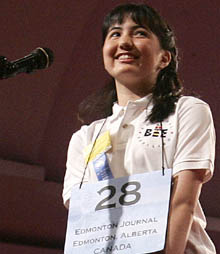
9:38: There are 14 Canadian spellers in this year’s Bee. This whole Canadian invasion took me by surprise. Apparently we allow any English-speaking kids into our national bee. Do other countries extend this same courtesy to us? How many kids out there have dual spelling bee citizenships? And how come almost all of the foreigners are Canadian – there really weren’t any British kids out there who could make the cut? The Brits are complete language snobs; I’m sure if Eton or Andover knew about this contest, they’d send a whole squad of ringers across the pond.

9:40: 14-year-old Finola Hackett from Tofield, Ontario is the two-time Canadian champ, which brings up an intriguing idea: How about rounding up the best spellers from all the English-speaking countries, and having them face off in a World Series of Spelling? These kids are the same age as the gymnasts at the Olympics. I just don’t understand why spelling hasn’t been awarded Olympic status yet.

9:42: 12-year-old Leslie Alix Newcombe from Don Mills, Ontario is the second Canadian speller in Round 5. As she says “zed” at the end of her correct spelling of ersatz (substitute, synthetic), there’s a long pause as the judges glance back and forth at each other. A few seconds later they remember: “zed” is how Canucks say “z”. See, this multinational thing has everybody else screwed up, too.

9:46: Hey – a Big Sur Marathon reference! 11-year-old Anqi Dong of Saskatoon draws the word nepenthe (something capable of relieving grief or suffering). There’s a day spa named Nepenthe in Big Sur, near the point where the buses turn around before dropping runners off. Take that, Boston – I’ll bet the word “Hopkinton” never makes the Bee.

10:20: The bell they use to signal missed words seems a little antiquated. Remember the spelling bee in the old Charlie Brown special called Snoopy Come Home? Whenever a kid missed a word, he or she immediately disappeared off the screen with the sound of a bubble popping. We have the technology to do this for real, don’t we? Imagine how cool it would be if, instead of the bell that signals a misspelling, the kid just vanished from the TV screen. I’m thinking of this as Chris Buchanan misses torrone (a candy made of honey and almonds).

10:34: Nidharsham Anandasivam requests one minute of “bonus time” pondering the word physis (the source of growth or change inherent in nature). Every contestant is entitled to one additional minute if they can’t spell their word in the allotted time – basically, they get one minute for free. You know, if I had one minute of bonus time at this year’s Big Sur Marathon, I would have broken three hours. Not that I’m still thinking about that.

Sometime after 12:00 PM: What? The biggest moment of this year’s Bee is completely missed by ESPN: after they cut away to SportsCenter at the top of the hour, 12-year-old Samir Patel is eliminated from the contest. A 4-time Bee finalist and last year’s runner-up, Samir was the odds-on favorite to win this year. Unfortunately, he couldn’t make it through Round 7, and won’t even appear in the prime time broadcast. (At home that night, I feel the same way I felt watching the Athens Olympics, waiting to see Alan Webb in prime time coverage of the 1500m, only to find out he didn’t even make it out of the qualifying heats. I'm not kidding - missing Samir is just as disappointing.)

Anyway, it’s been a busy morning after 7 rounds, and 13 spellers remain. It’s time for a break. See you in prime-time.

8:00 PM: The moment has finally arrived: Welcome to the first-ever prime time coverage of the National Spelling Bee!

8:01: After an opening montage, the first image from the Ballroom is the 13 remaining spellers huddling in a circle, holding their hands in the middle, then cheering “1-2-3-spell!” Let me put it this way...what if all the competitors in the Olympic 5K final stood at the side of the track, held hands, and cheered “1-2-3-run!” How corny would that look? That’s exactly how this photo-op cheer comes across. Remember what I said about ABC making unnecessary changes? 1 minute into the broadcast, here is Exhibit A.

8:05: Now it’s definitely a big-time event: For its prime time coverage, ABC has replaced Chris McKendry with Robin Roberts. Remember when Robin was a SportsCenter anchor on ESPN? One of her catch phrases was “Go on with your bad self!” Maybe if some kid does the fist-pump-to-chest or does a jersey pull after spelling a word correctly, she’ll use the phrase tonight. Unfortunately, these kids are either too classy or too oblivious to even know what a jersey pull is, let alone to do one at the prime time Bee. What a missed opportunity.

8:07: As the camera pans across the faces of each seated competitor, most of them give a little wave or nervous smile. Not Rajiv Tarigopula. The 13-year-old from St Louis stares down the camera with his best sneer. He’s like Ivan Drago staring down Rocky Balboa and saying, “I must break you.” The broadcasters mention that with the elimination of Samir Patel, Rajiv is now the favorite to win this year’s Bee.

8:45: After Finola correctly spells formenkreis (a species with many subdivisions), Paul Loeffler tells us, “She has the weight of a country riding on her shoulders,” and later in the competition says she “has the attention of her whole nation.” Um, really? Aren’t the Edmonton Oilers in the NHL Finals right now? Are more Canadians concerned with the bee than winning the Stanley Cup? Is Finola more popular than the hockey team in her hometown, which is a suburb of Edmonton? If she wins, will they engrave her name on the championship cup like the Oilers will on Lord Stanley’s? Actually, the trophies look remarkably similar. This is making me nervous. I think I’m pulling for the American kids now.

9:01: The kids seem to be getting an awful lot of French and German words thrown at them in this year’s Bee. Which leads me to wonder: do bees in other countries borrow Americanized words to puzzle their finalists? Are there kids in France or Germany who are memorizing lists with words like crunk, hollaback, and bootylicious? For some reason, that would make me happy if they were – especially after Nidharshan is eliminated by paillon (a thin sheet of metallic foil).

9:24: It’s cool that Finola is doing so well, but here’s the thing: She’s had a remarkable number of French-origin words (guilloche, douane, machicotage, esquisse) in succession to get her through the later rounds. Isn’t French like a second language in Canada? I mean, if I entered a Bee and drew a list of words like anaerobic, fartlek, aquaphor, and Gallowalk, wouldn’t I have pretty good shot at advancing? Although all of these kids are enormously well-prepared, there’s certainly a “luck of the draw” element to this event.

(And I’m not one to suggest a conspiracy at play here, but head pronouncer Jacques Bailly also happens to be of French descent. To recap, that’s a French judge giving French words to a French-speaking contestant. Just thought it merited mentioning.)

9:36: Everyone in the Grand Hyatt Ballroom is stunned. Rajiv can’t nail the correct spelling of heiligenschein (a light around someone’s head caused by diffraction of light), and is out of the competition. Rajiv clearly thought he would win. The broadcasters thought Rajiv would win. Millions of television viewers thought Rajiv would win. Heck, even the other spellers thought he would win. He gets a standing ovation before leaving the stage. But now the most talented competitor who was the clear favorite has been eliminated in the final four…and all of a sudden I’m having these crazy Chris Daughtry flashbacks. You know, it's possible that I've been watching too much TV lately.

9:46: Saryn Hooks misspells icteritious (of a jaundiced color), and we’re down to the final two: Kerry Close and Finola Hackett. USA vs. Canada. This is the matchup everybody wanted in the Olympic hockey tournament four months ago, but never got to see. Now two eighth-graders are left to duke it out for national bragging rights. Hey, kids, no pressure here or anything – it’s just a letdown to your entire country if you lose. Have fun in Round 15.

9:58: During these final rounds, Finola has slowly won over a large percentage of the crowd. Maybe the audience is hoping she’ll be another Tanith Belbin: she’s very pretty, she’s incredibly talented, and if we cheer for her loud enough, maybe she’ll defect to the United States a couple of months before next year’s Bee.

10:04: After sailing through round after round of French words, Finola meets her match in the German weltschmerz (a type of emotional depression). She heads back to her seat with a dejection and dismay. She couldn’t spell the word, but now she’s actively demonstrating it. Unfortunately, the national Charades championship isn’t for another few weeks. On the bright side, I’m positive that the Oilers will honor her between periods at a hockey game this week.

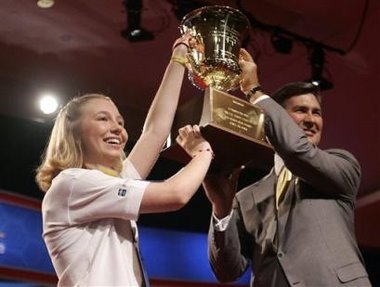
10:08: The audience lets out a collective gasp when Dr Bailly announces the final word ursprache (a parent language). Will German words knock out both of the top spellers? Considering the moment, Kerry Close appears relatively unruffled, and after a few deep breaths, spells the word correctly to claim the championship.


She immediately backs away from the microphone, hands clasped over her mouth in astonishment, and runs off stage to hug her parents. No chest pounding, no jersey pull – just a classy reaction from a gifted girl. She’s a picture of joy as the MC comes over and helps her raise the champion’s cup – the cup that’s staying in America for at least another year.

So tell me: where else but the Bee would international intrigue and nail-biting competition go hand in hand with pre-teen awkwardness and obscure academia? Year after year, the NSB consistently delivers the goods. That's why I'll be watching again next year.

And it's crazy, but usually I get the same kind of weltschmerz after the National Bee that I do after my favorite races, in that I know I have to wait another full year to experience it once again. This time though, I don't feel quite as depressed, because I have my own personal nepenthe: a great new book to help soften the blow.

So now if you'll excuse me, I have some reading I'd like to do.


See other installments of this series on sidebar at right.

Read more...

June 2, 2006

Spelling and Biking (And Walking and Riding)

Wow. So much to say...where to start? I guess I should start by saying that this isn’t my official National Spelling Bee recap post – I need at least the weekend to sort things out in my head and get them down on paper (on Microsoft Word, really...but the phrase “get them down on my computer” just sounds funny). But needless to say I was captivated. Here are a couple of thoughts off the top of my head:

1) Who would have thought that the NSB would develop a subplot as an international showdown? The final standoff felt like watching a gold medal match at the Olympics. The whole Canada angle of this Bee has me spinning…let’s just say I’ll explore this further next week.

2) My preliminary verdict on ABC is that they overproduced the competition. They tried a lot of new wrinkles, most of which weren’t very successful. This is a universal truth that I never comprehend: whenever somebody new takes over something (a new boss, new restaurant ownership, a new coach, etc), they always feel the need to change things just because they have the ability to do so. If something is already successful, most of the changes ineviatbly come off worse than the way things were before. Last night’s telecast was a good example of this. But thankfully they didn’t go completely overboard with it.

3) If the legions of home-schoolers were hoping to dispel the perception of home-school kids as quirky intellectuals with enormously overstuffed bookshelves in their house, who enjoy reading dictionaries and encyclopedias when they aren’t playing video games, well…last night’s telecast may have been a minor setback.

I’m stopping there for now. Trust me, there’s more to come next week. In the meantime, I was going to write more about the Dipsea today, but then I went on this bike ride yesterday, and I think it’s a more compelling story.

I was scheduled to work about 12 hours yesterday, so I figured I’d take a quick spin on my bike for about an hour at midday.

I made a beeline out of Salinas through the campos for about 25 minutes. Salinas is a fairly small town, and if you head directly through the fields, you come upon vast open stretches where development stops and very few cars travel and where the natural landscape provides overwhelming solitude.

It was in just such an area that my bike chain broke.

It didn’t just come derailed or unsnapped – it tore apart in about three places. The simple chain tool I had with me wasn’t adequate to fix it. It was beyond repair.

For dramatic effect, this might be a good time to mention that I don’t own a cell phone.

Essentially I was stranded, many miles from civilization. Every time I get on a bike, this is my single greatest fear. And now it was happening for real.

I kick-push-coasted on my bike for about two miles to an intersection of two county roads, then walked for another half mile pushing my bike with one hand, holding my chain in the other, holding my arm out to hitch a ride.

Eventually a girl with a bike rack offered to give me a ride, but she wasn’t going to Salinas. She took me as far as a gas station in the nearby town of Seaside, where I used the payphone to call a cab.

Two hours, one humiliating cab ride (Do all cabbies feel the need to blather endlessly, regardless of whether the person in the back is responding? Do they learn this in cabbie school? This was unquestionably the most uncomfortable part of my day), and 40 dollars later, I was back at work. Once I add the cost of buying a new chain and repair tool, it will turn out to be a very expensive bike ride.

I love cycling. I really do. But yesterday was a perfect example of why running will always be my full-time pursuit. I know situations like this aren’t a common occurrence, but just the thought that the possibility exists with every ride is enough to stress me out at times.

I mean, would anything like this ever happen if I was running? The only similar thing I can imagine is if I were deep in the forest somewhere and happened to break a leg bone, eventually signaling a search and rescue group to bail me out. But even then, I’ll bet the search and rescue guys wouldn’t drive me nearly as crazy as 20 minutes with that cab driver did.

Anyway, I made it back and finished work and despite the expense, things pretty much turned out fine. I’ll probably even get a new chain for my bike and try another ride soon.

But I might need to reconsider my cell phone situation.

Read more...

June 1, 2006

Running and Spelling

(Actually, if taken in order, it would be “spelling and running”…)

Part 1: Spelling

It’s Thursday afternoon, and I’m at work. And not watching the preliminary rounds of the National Spelling Bee. Apparently, watching the Bee doesn’t justify taking a whole day off to some of the senior management and administrative personnel I work with. Whatever. Some people just don’t get it. Thank God for TiVo.

I’m also distressed about the technological apathy in multimedia coverage of this event. I mean, we can land a rover on Mars that sends photographs to Earth, and we can film the migration of animals from space satellites, but we can’t watch streaming video of the Bee on our laptops at work? Isn’t technology supposed to improve our quality of life? What’s more agonizing than knowing the capacity exists to do something, but nobody cares enough to implement it? I swear, that Bee should hire me as a PR consultant one of these years.

I’ll watch the coverage on TV tonight, of course. I’m interested to see what ABC does with it. I’m excited to see how the competition unfolds. I’m curious to see if anyone passes out. In this competition, nothing surprises me anymore.

But since I’ll have 3 hours of prelims to watch before the main event, and since we’re getting the West Coast feed, the event will be long since over before I learn who wins. That’s why our house is going into an electronic cone of silence tonight - I’m not looking at e-mails or the Internet, and not answering the phone. You think I’m exaggerating, but I take this thing seriously. Tonight could be a very late one, like when the CNN anchors stay up past midnight to announce election results. Only in this case, it’s for something really meaningful.


Part 2: Running

This morning I hit the track again, in yet another attempt to transform myself from a Clydesdale into a thoroughbred in a short time span. I go through this process every year, and it never works well.

There are usually only 6 weeks between the Big Sur Marathon and the Dipsea Race, which happen to be my two favorite races. Six weeks may seem like a long time, but when you factor in one rest week after the marathon, and another week of fatigued running, it doesn’t leave a whole lot of time for quality training.

The Dipsea is an intense race. It requires prolonged anaerobic efforts on the steep climbs, bursts of explosive speed to pass people, and high-end footspeed to make up ground on those who start ahead of you. In other words, you need to race like a thoroughbred. The best way to train for it is to mimic these conditions with sprint workouts and high-intensity hill repeats built up gradually over a long period of time.

Unfortunately, I spend the beginning of January through the end of April logging high mileage, long-duration workouts in my marathon buildup. I’m very careful not to overdo the speed work in fear of injury. Like a Clydesdale, my top end speed is never great, but I can sustain my “pretty fast” speed for a long period of time – which is exactly what you want for a marathon. The training gets me in great shape to race 26.2, but inappropriately prepared for the challenge of the Dipsea.

So when the calendar turns to May I start doing shorter, faster speed work sessions, and racing up the steepest hills I can find. These workouts are always a shock to my system, and I’ve often made the mistake of trying to progress too quickly. Many years I’ve arrived at the Dipsea with a muscle pull or minor injury because of my short-cycle training approach – and I end up racing worse than if I hadn’t done any sprint workouts at all.

So far this year, I’ve been doing OK. The track workouts have been intense, but maybe just one notch lower than what I typically do in May and June. I’m sore but not injured. And my speed is slowly coming around. If I can avoid screwing things up for a week and a half, I should be in halfway decent race condition.

But I don’t have any lofty ambitions for myself next weekend – as I’ll describe more in my next post.

(You know, after I come out of the cone of silence...)

Read more...
Related Posts with Thumbnails

  © Blogger template The Professional Template by Ourblogtemplates.com 2008

Back to TOP