August 21, 2006

Fractured Fairy Tales

I can’t overemphasize what a nice outlet blogging has been for me.

After all, it’s not like I started this blog and then became a quirky, neurotic, running-obsessed oddball. Those elements of my personality have always been present – but prior to Running & Rambling, they just manifested in other ways.

Exhibit A: Last night I found a spiral notebook belonging to my 5-year-old daughter. It’s about 4 inches high, covered in fuzzy purple felt, with a crowned-shaped mirror above the word “Princess.” The notebook has served as my daughter’s doodle and art book for the past few years.

This particular daughter is the budding artist in the family; she constantly makes paintings and pictures that end up all over the walls of our house, my office, and even her grandparents’ house. We have a designated craft table for her, and when she was younger I used to sit there beside her doodling my own sketches and stories while she colored.

I hadn’t seen the notebook for several months before last night, so I started flipping through it to see what she had drawn and I had written. The stories are very short (remember, it’s a 4-inch page), but they give a glimpse of the future blogger at a formative stage.

Also, based on the content of my writings, I could tell what book or TV program I had been exposed to at that time. For example, here is one story I came across:

***
“Will you accept this rose?” asked the princess.

“Of course I will,” he replied, “but I’ll have to skip the champagne. I was hoping to go for a long run tomorrow, and I have to get up early. Plus, I sometimes get migraines if I’m dehydrated, so I’m trying to limit my alcohol intake. And would it be OK if we just hang out at home for our next date? I’m kind of worn out from ramping up my mileage this week.”

The princess considered this and said, “Um ... Can I have my rose back?”


***
Obviously that was during a season of The Bachelorette. Another time, after reading a book of princess stories, I jotted this down:

***
From across the table, their eyes met, and they both knew it was meant to be this way; for them to meet in this exact place at this precise moment. He wanted everything she had to offer, and she had been long awaiting his arrival.

As their bodies drew closer, everyone around them faded from view. The time they shared seemed frozen, as if God intended this instant to linger longer than all others. But despite their mutual infatuation, they both knew it couldn’t last.

He reached for her … then took the Gatorade cup from her hand, and shouted “Thanks!” before continuing down the road.

***
And one more - after watching Shrek, sometime during a marathon training period:

***
“Attention! I have an announcement to make!” shouted the king.

“In a dragon-guarded castle in a faraway land, the princess awaits your arrival. Take heed - the journey before you is long and treacherous.

“A route map and course elevation guide were provided in your goody bag. Each mile will be marked, and a volunteer will shout your split times as you pass. Aid stations every 3 miles will provide Gatorade and GU, and Vaseline will be available during the final 10K. The winner will be the first person to rescue the princess, regardless of chip time.

“Friends of the princess will be available at the castle to provide massages to all participants.”

***
And so on and so on. But now instead of jotting down mindless stories in my daughter’s sketch book, I have this blog to accommodate such ramblings.

No longer limited by a 4-inch page, I can write as much nonsense as I want. And my daughter’s probably happy that I’m not taking up so much of her notebook space. In those regards, the blog has been beneficial to each of our respective interests.

On the other hand, the question of whether anyone outside our family is better off for such a development is certainly debatable.

Read more...

August 18, 2006

See Me Rollin'

One administrative note before today’s post: After my last post, a couple of people mentioned that my yellow swim cap might actually attract sharks, which is obviously a situation I’d like to avoid. Apparently they forgot to mention that little fact on Mythbusters. So next time out, I’ll be wearing the pink cap that I’d shamefully buried in my sock drawer - you know, unless someone tells me that pink attracts orcas or something.

It’s also a good reminder of what I’ve said multiple times in this space: sometimes I’m a complete idiot.

On with today’s post…

***
“They see me rollin’ … they hatin’ …
Patrollin’, they tryin’ to catch me ridin’ dirty …”

- Chamillionaire, “Ridin’”

(Before July, I thought those lyrics referred to Chamillionaire’s experience with racial profiling while driving his pimped-out SUV. But recently, another thought occurred to me … do you think Chamillionaire is a Tour de France fan?

And yes, I heard that song on my newly reformatted rap/rock radio station. They’re still tormenting me with that.)


In the summer of 1998, I decided to train for my first triathlon.

I was on a limited budget, so instead of investing in a tri-bike, I bought a pair of slick tires and aero bars, and gave my Specialized RockHopper an extreme makeover.

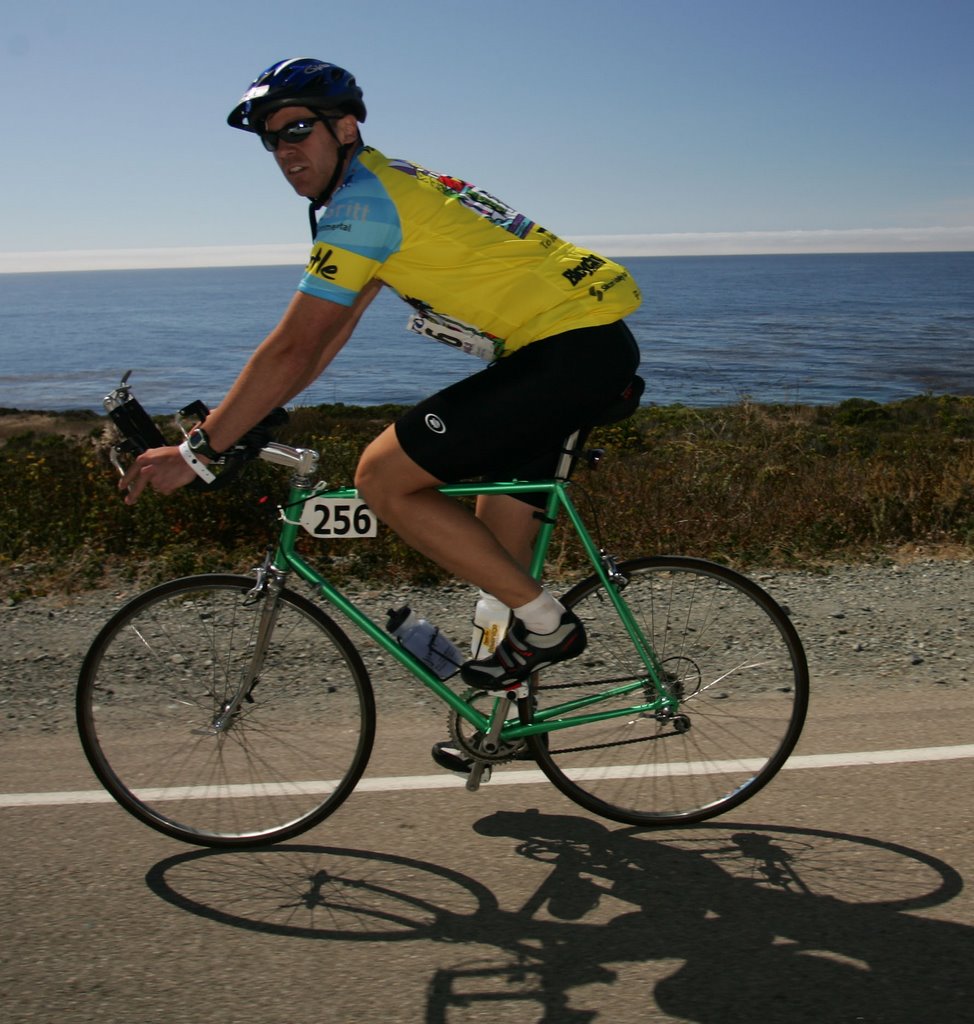
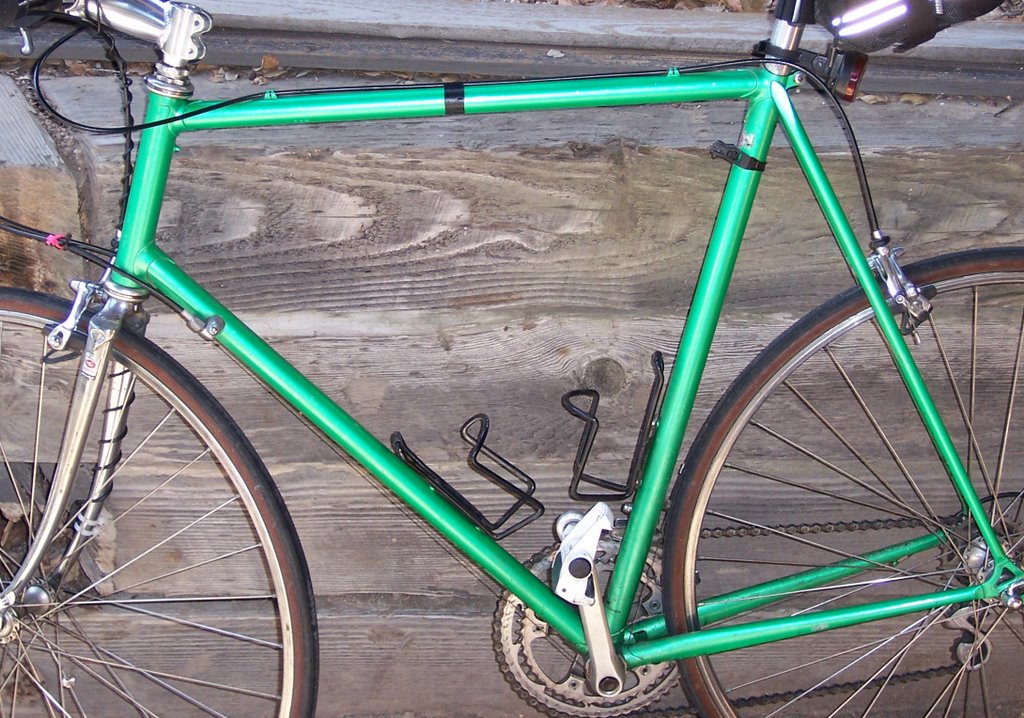
I did hundreds of training miles on that bike, until a friend decided to upgrade his own racing bike. He knew about my bike, and asked if I wanted to use his old tri-bike (which he called the Green Machine - see below) for the race.


He and I are roughly the same height. The bike weighed about half as much as my RockHopper. And it was free. It took me about 2 seconds to accept the offer.

The bike was already about 15 years old at that time, but still had the stiff frame and smooth machinery that was top-of-the-line material in the 1980s. And at that year’s triathlon, I rode the thing like I stole it. The bike segment was undoubtedly my favorite portion of the race, and I nearly matched the pace that my friend posted on his new mack-daddy ride over the Olympic distance course.

After the triathlon, my friend told me to keep the bike (and wouldn’t take any money for it – now that’s a friend), and the Green Machine became mine. It typically hibernates for the winter, but when the weather gets warm and I’m training for another tri, I’ll log several hundred miles on it over the course of a few months. Last October I did a very hilly 100-mile ride from Carmel Valley to Hearst Castle (picture below) like it was a ride through the park.


However, the Green Machine is starting to show its age. While the bike itself hasn’t become much slower, the world of bicycle technology has continually advanced, to the point that any $800 road bike today has a much lighter frame and more superior components than I can compete with. (Although I still hold my own pretty well – more on that in a second).

So if you’re somebody who uses the term “bike porn” for pictures like these, think of the Green Machine as Vanessa Del Rio. Back in the day, there wasn’t anything as well-built or immediately exciting. She had the best geometry around, and set the standard for high performance. Nowadays she’s got about a million miles on her and looks totally overworked and outdated, but under the right circumstances she can still deliver the goods.


Today there are models who are much younger, better-looking, and come augmented with expensive components to make your ride even more exhilarating. And sure, I could go out and get myself a Jenna Jameson, but sometimes I don’t see the point – especially when I’ve got a model that gets me to the same, um, finishing point anyway. Yes, Jenna would probably get me there a little faster, but I’m not shooting for an age-group win or an Ironman slot – so isn’t it OK to take a few extra minutes to enjoy the ride? Sometimes the experience is about more than just speed, right?

Each summer, I tell my wife that this might be the last year before I upgrade to something lighter and faster. I’ve been saying that for almost nine years now. I’ve done several more triathlons since that first one. So I guess you could say that my needs have been met – and that’s really all that any guy can ask for.

Finally, about the name: I didn’t pick it. My friend called it the Green Machine for years before it became mine. I never gave any thought to naming my bike like a lot of cyclists and triathletes do. Perhaps since I always thought it would be a temporary companion, I purposely didn’t name it, to avoid becoming too attached – you know, kind of like finding a stray puppy. So even though I sometimes called it the Green Machine, I just always considered it “my bike.”

Then this past weekend I went for a ride with a group of guys riding Kestrels, Trek Madones, Cannondales, and similar high-end bikes. I felt incredibly strong, easily chasing down any riders who went off the front, and lowering the hammer to pull away on every major climb. As we regrouped at the top of a hill, one rider looked my bike over, and came up with this:

“It’s big, green, ugly as hell, and can rip our legs off. You should call it Shrek.”

I thought it was a fantastic idea. And seeing as how I’ve watched that movie about 100 times, it’s amazing that I didn’t think of it first. So even though I’m not into naming things, I’m actually going to think that one over.

Read more...

August 16, 2006

Shark Bait?

"Takin' on the jellies ... awesome."
- Crush (to Marlin), from Finding Nemo

Conventional wisdom says you should never swim in the ocean alone. Yet I frequently do solo open water swims in Monterey Bay.

It’s not that I’m purposely irresponsible. I just don’t see the paranoia about this particular aspect of training.

It’s also a matter of convenience. I only know about three people who would take me seriously if I were to say, “Hey, I’m planning an ocean swim this week – want to join me?” When we try to coordinate days of the week, or particular times of day, pairing up with somebody never seems to work. It’s easier and faster to simply go it alone.

The thing is, I don’t consider it a particularly high-risk behavior. In many ways, open water swimming seems just as safe, if not safer, than the other two triathlon disciplines. But I’ve never had people tell me not to ride or run alone. So what gives?

In the spirit of due diligence, I’ll examine the main reasons people use the buddy system, and give my justification for ignoring them.

Reason #1: Someone knows where you are

Here’s what I do in Monterey: I head about 200 yards away from the shore, then turn and swim parallel to the beach. I’m never more than a quarter-mile from the sand. I wear a bright yellow swim cap, which catches the eye of observers on the beach.

I know this, because when I breathe to the side facing the beach, I frequently see someone doing the “one hand shading the eyes with the other hand pointed out toward me” stance while talking to a companion. Sure, they’re probably saying something like “Wow – look at that idiot swimming alone!”, but at least I know I’m noticed.

On the other hand, I can’t count the number of times when I’ve been on some remote trail, many miles away from anything resembling civilization. In those situations, if I were to break an ankle or have a heart attack, I might lie there for days before anyone discovered me.

In either case (swimming or running), once you venture into the wilderness, the only guarantee that you’ll return safely is your own self-reliance. Perhaps this is a foolhardy notion, but at least I’m consistent in my recklessness.

I realize, however, that those spectators from the beach can’t do much for me from the shore. Which leads me to…

Reason #2: You can get help if needed

People say the buddy system allows one swimmer to get help if the other is in trouble. This premise assumes a lot of factors that may not actually transpire.

Being in a group of ocean swimmers isn’t exactly like a social jog through the park. Everyone swims at different speeds. Very few people swim in a straight line. It’s nearly impossible to communicate above the noise of the wind and waves when everyone is wearing swim caps. Foggy goggles and choppy ocean swells often eliminate your peripheral vision. (Put it this way – there’s a reason every tri course is lined with kayakers. Is there any other sport that employs people merely to ensure that the participants stay in bounds?)

In these situations, each swimmer is practically on his or her own anyway. The best you can do is to have a designated turn-around point where you count heads to make sure no one is missing. But if someone starts choking and drops from the group, it could be 15 or 20 minutes before anyone notices and starts looking for him.

That’s assuming the group would even decide to look. I’ve been in groups where we count heads at the turnaround and come up a couple people short. Somebody usually concludes that those people must have turned back early, and thankfully, that’s always been the case.

My point is that merely having other bodies in the water doesn’t necessarily make you safer. Besides, if I had a medical emergency in the ocean, it’s not like my partner could do CPR on me out there. But could he help me with…

Reason #3: Predator attack

This is the thought that strikes fear into the hearts of novice swimmers everywhere. Nobody likes to picture getting attacked and devoured (on that thought – I loved Deene's comment on my last post, quoting Gil from “Finding Nemo” and saying that I would now be known as Sharkbait. It takes skill to trash talk someone by using a pop cultural reference that’s precisely topical. I wish I had thought of it first.)

Anyway, the potential for attack comes in two varieties: the “rip your limbs off and kill you immediately” method (like a Great White shark), and the “injure or paralyze you just enough that you’ll die a slow death before scavengers pick you apart” technique (like jellyfish). Granted, both of those ways sound pretty unpleasant. But think of them in running terms, and see if they still horrify you.

• Great White attack. This is a legitimate fear in some ocean regions, especially on the Northern California coast. But do you know how many shark attacks have been documented in the entire history of Monterey Bay? Exactly one. I know this statistic because my son and I saw it on Mythbusters – and those dudes wouldn’t lie.

Anyway, the Great White in the ocean is like the mountain lion in the hills: yes, it’s out there. Yes, it could kill you in a flash. But it doesn’t want anything to do with you, and would rather remain unseen.

The odds of you being attacked are a much lower magnitude than being struck by lightning. Sure, it could happen. But are you so terrified of lions that you avoid running on trails?

• Jellyfish sting. Unless you’re swimming in Australia, you’ll never find a jellyfish that can kill you with its sting. The real danger is suffering mild muscle paralysis, which can lead to drowning, so swimmers are advised to exit the water if they ever get stung.

Although I’ve seen several jellyfish in the ocean, I’ve never been stung – or if I have been, the wetsuit protected me from it. But if I do get stung, I’m close enough to shore that I could make it out of the water to get assistance.

Think of jellyfish as the rattlesnakes of the ocean. Your odds of being stung or bitten are roughly the same. Attacks usually happen by accident – stepping on a snake, or swimming into a jelly. The proper response to both incidents is to get antivenin as soon as possible. You should know these things, but you shouldn’t avoid the activity for fear of them.

In the end, what it comes down to is your willingness to take a calculated gamble. There is inherent risk of harm in running and cycling (I haven’t even mentioned getting hit by a truck yet) just as with ocean swimming. If you run or cycle alone, you knowingly diminish your chance of having help available should you need it.

Yet if you love trail running, you’ll take those odds to do something you enjoy. Ocean swimming is no different, and that’s why I usually don’t have any qualms about going solo.

(Finally, on a related note…if my body should wash up on the beach someday, would someone kindly submit this post along with my nomination for the Darwin awards? I’d appreciate it.)

Read more...

August 14, 2006

Mine! Mine!

(Administrative note: With my triathlon less than 4 weeks away, the next several posts will have a more noticeable tri-vibe than in previous weeks. Reader discretion advised.)

Friday evening found me at Wharf #2 of the Monterey Harbor, pulling on my wetsuit before heading out for an open-water swim. It was a nice evening by Monterey standards, with an overcast sky, air temperature in the high 60s, and a relatively warm water temperature of 62 degrees.

(Before you ask…yes, I was alone. More on this in another post.)

It had been quite a while since my last open-water swim, so I wasn’t sure how my stroke would feel. I started off fairly easy, and was pleasantly surprised to find that everything felt much smoother than anticipated. All that yardage in the pool must be paying off.

I maintained an every-third-stroke breathing pattern, stayed relaxed in response to the unpredictable swells and chop, and kept a steady course toward the faraway building I was sighting (one advantage of swimming in Monterey Bay is the curvature of the coastline, allowing swimmers to see land in the distance on three sides). Everything was going, well…swimmingly.

Seals are plentiful in the bay, and I’ve become accustomed to seeing their dark, rounded heads poking above the waves to stare at me as I turn my head to breathe. Sometimes when they are especially playful, they’ll criss-cross underneath my path, or swim parallel to me, keeping their head above water to keep tabs on my progress.

When I first started swimming in this ocean, it was somewhat unnerving to encounter various sea animals dashing in and out of my field of vision. Over time, though, I’ve learned to relax in the presence of the creatures that dwell in these coastal waters.

On the other hand, creatures of the air torment me incessantly.

Such was the case on Friday, when approximately 30 minutes into the swim, I noticed a gray seagull swooping down to within a couple feet of my head. He seemed to coordinate his descents so that he could see my face from close range whenever I turned to breathe.

There’s a back story involved here. For the sake of brevity, let’s just say that I have some, um…issues with birds. A checkered history, to put it mildly. (If you really want the long story, I wrote about it here.) So a hovering, possibly aggressive seagull directly overhead nearly put me into panic mode.

He stayed close above, repeatedly diving toward me for nearly a full minute before flying off toward a group gathered just offshore. I had a brief respite before the return of a different, white-and-black seagull, who also dropped in to get a look at me, coming nearly close enough to touch at times.

I was perplexed as to what could be causing such behavior. In my weary state, I envisioned a conversation amongst the nearby group of birds:


Bird leader: Hey – that looks like a wounded seal. Maybe there’s some scavenger fish nearby. Someone go check it out.

Gray seagull: I’m on it.

Bird leader (as gray returns): Well? Do we have a meal?

Gray: Nah…it’s some dude. Trying to swim, I think.

Leader: Really? That can’t be. Nothing swims like that. Is he wounded? Maybe there’s some scavenger fish anyway. Someone else check (white seagull departs).

White seagull (returning): No scavengers. It’s a dude. He looks bad, though. Let’s check on him later.


Luckily, it was only another 15 minutes before I was safely on shore, and the birds decided to go try their luck elsewhere.

I’m not exactly sure what being harassed by waterfowl says about my swimming prowess. Maybe I should be flattered to be mistaken for any type of seal – even a wounded one. Maybe I need to consult Stronger for some tips on my form. Or maybe I just presented a strange curiosity that the seagulls found interesting on an otherwise routine evening surf patrol.

All I know for sure is that they managed to make my relaxed evening swim significantly more nerve-racking than I intended. And they certainly haven’t made me grow any fonder of birds.


Read more...

August 11, 2006

Go All-In

“Shove me in the shallow water, before I get too deep”
–Edie Brickell, “What I Am”

If you’re a regular visitor here, you’ve been subjected to five straight drug articles.

If you’re not a regular visitor, perhaps you stumbled here after doing a Google search for “celebrity breast augmentation” or “Amsterdam hookers” or “female Viagra”. In that case, um…you know this blog is mostly about running, right? I don’t want be mistaken for TMZ.com or The Smoking Gun or some online sex shop (find your own link).

Either way, the drug series got a little heavy-handed, and very long-winded. And as I told Rob, I think I peaked too early by talking about artificial breasts in the first installment – after that, the bar for stimulating interest was set pretty high, and I may have overreached a bit while trying to keep your attention.

Next time, I’ll know to build momentum gradually, and save the sex talk for later in the series. Obviously I still have a lot of things to learn about writing.

At any rate, it’s time to shift gears. I’m taking the easy way out, by posting our Herald article from last week.

I first wrote about the World Series of Poker in 1993, thinking it was a flash in the pop cultural pan; a mindlessly amusing diversion that would soon go the way of Joe Millionaire or the Macarena.

Instead, televised poker continues to be a huge draw, and thousands of new players appear out of the woodwork every year. Likewise, the throwaway article I wrote three years ago turned out to have some legs – I’ve tinkered with it and republished it twice since then, including in last week’s Monterey Herald.

Here’s the version that appeared last week:

***
Running Life 8/3/06 “Go All-In”

Without a doubt, poker is hot.

High-stakes tournaments are televised year-round on various networks, and it seems like everyone wants to try their luck and live like The Gambler. Heck, even the Monterey Herald now has a regular poker column to teach a novice player how to work his short stack into a huge pile. We’re pretty sure those are poker terms.

As we write this column, the World Series of Poker (WSOP) is underway in Las Vegas, with $12 million awaiting the winner of the main event. The WSOP is televised on ESPN, and it’s a unique glance into the world of high-stakes gambling that the vast majority of us are too poor (the entry fee to the main event is $10,000) or too terrified to enter.

The contestants make for fascinating viewing - it's the biggest collection of geeks and oddballs this side of a Star Trek convention. Harvard PhDs compete with uneducated laborers, mathematic whiz kids stare down vice peddlers, and fresh-off-the-boat immigrants play alongside old-school Texas oilmen.

There are high rollers, Jesus freaks, pregnant women, and LOTS of fat guys. If someone could invent smell-o-vision, we would even sense the cigar stench and the stale nachos and the B.O. (come to think of it, maybe we could do without smell-o-vision).

The main event of the WSOP is one of the most ruthless varieties of poker, called No-limit Texas Hold 'Em.

Since this is a column about running, we’ll pose two questions: 1) Can poker legitimately be called a sport, or its players be considered athletes? And more specifically, 2) Are there any lessons that runners and other recreational athletes can learn by watching?

The answers may surprise you.

Actually, question #1 is easy: no one would dare call card players athletes. Even casual observers can take one look and tell that these folks aren't the smoothie-after-a-workout types.

However, question #2 is more complex. No-limit hold ‘em does have some parallels to running. One dramatic similarity is the most exciting aspect of the game, when players decide to "go all-in".

In the no-limit game, anyone can wager their entire stack of chips on any given hand. If you have a higher chip count, you can go all-in against a lower stack to intimidate him off a hand, further building your pile. If you go all-in with the low stack and lose the hand, you're out of the tournament.

You would think players would reserve such a gambit for only a few premium hands, but in fact it's done all the time. Tournament rules require increasing chip bids for each hand, so the player who plays conservatively will slowly bleed his chips away before the ideal hand comes along.

Thus, going all-in is a necessity, as players are unable to win large pots or knock other players out without this tactic.

Think of going all-in as running a race. It represents a time to push all of your chips onto the table, reveal your cards, and see who comes out on top.

In poker, the decision to go all-in is partly based on your opponent: do you think he has a better hand? Can you get a read off of him that indicates what cards he is holding?

In racing, we're often concerned with how we will perform in comparison to others. Some of us try to beat our training partners. Others try for age group awards, while some are simply afraid of finishing dead last.

Obviously, the fear of losing is the most nerve-racking aspect of going all-in for professional card players. In no-limit poker, any given hand could result in sudden elimination.

Similarly, with every race, runners risk failure or disappointment with a poor showing. But just as there is no way to advance in the WSOP without going all-in, there is no better way to improve our performances than by periodically putting everything on the line in a race.

Any of us who are concerned with PRs, age group places, and comparative times from year to year need to go all-in on a regular basis - not just when we have the perfect hand.

Without the motivation of the next race looming, many of us would tend to ease up on our training, gradually losing our edge and our speed, the same way a pile of chips dwindles away one hand at a time if never risked.

Don’t be afraid if racing gives you a major-league case of the jitters. That’s the nature of competition. For gamblers, this is the "juice" that draws them to the table - the panicky tension, the drama of exhilarating highs and gut-wrenching lows based on the fall of the cards.

Runners become hooked on racing in search of the same thrill. In fact, many coaches say that if you aren't terrified before a race, you aren't properly prepared for it.

So maybe runners and poker players have more in common than it first appears. Running also brings together people from disparate backgrounds. Some of us are oddballs. And although there aren't quite as many fat guys in our group, we know plenty of runners with B.O. issues.

Runners often use the phrase "go all-out" to indicate their maximal effort in a race. Next time, try this: when you are lined up at the start line, envision pushing a big stack of chips into the middle of the road, and commit yourself to going all-in.

Read more...

August 9, 2006

Color Me Sadd

OK – let’s bring things to a close. All this talk about drugs is just bumming me out. So I’ll use today’s post for some final thoughts before we shift gears.

The funny thing is, I feel like I’ve written extensively about the subject, but I’ve barely scratched the surface of angles to be considered. Like I said right off the top, the scope of this problem is enormous.

Yesterday I said that the way we look at sports has been changed. In many ways, it strikes right to the heart of our belief system: is it better to have full awareness of the corruption and dishonesty that produces memorable athletic performances, or to remain ignorant and celebrate the accomplishments as if they were legitimate?

Nothing can be taken at face value anymore. With all individual (as opposed to team) sports, any dominant victory or unexpected performance immediately and automatically casts suspicion – justified or not - on the athlete. Instead of appreciating such heroic moments, we’re forced to wonder whether the feats were attained honestly, and whether they will be overturned in the following weeks.

There will never again be another moment of pure admiration regarding an individual athletic accomplishment. Even if a “clean” athlete somehow manages to break a world record, he will be presumed guilty based on the sins of his predecessors.

Consider the case of Jamaican sprinter Asafa Powell, who now stands as the sole 100m world record holder after the disqualification of Justin Gatlin. Before Powell had the record, it belonged to Tim Montgomery, who also tested positive. Are we as fans really supposed to believe that a clean sprinter could beat the best times of two world-class sprinters who also used drugs? It’s a notion that stretches the imagination.

Who was the last clean runner to set the 100m world record? Maurice Greene, or someone from the 1990s? Or do we have to go back further, to Carl Lewis or beyond? It’s become a parlor game. Powell may very well be clean, but there’s no way we’ll ever know for sure. Although he has never been implicated in any wrongdoing, he has an inevitable guilt by association with other sprinters that will always cast suspicion.

As spectators, we’ve somehow collectively decided whether or not to trust an athlete based on his nationality, his upbringing, or the image he has cultivated during his time in the spotlight, rather than evidence that appears contrary. Thousands of San Francisco Giants fans will still tell you they think Barry Bonds is an innocent victim of overzealous persecution. If Floyd Landis were French, would so many Americans try to give him the benefit of the doubt?

I'm one of the biggest Lance Armstrong fans you'll ever find, but if you ask me whether or not he used drugs, I'll tell you honestly that I have no idea. I like to think he didn't. It goes back to that belief system: sometimes it’s just easier to believe that our favorite athletes got where they are through honesty, hard-work, and God-given talent – because any alternative scenario is too depressing to consider.

I remember when I was young, watching the Olympics and the Tour de France with a sense of wonder and awe. Perhaps it was childhood naiveté, but when I watched those events, there was always an underlying premise that Olympic dreams were available to anyone with the right ability and the dedication to work towards greatness.

Undoubtedly, my generation will be the last to grow up with this mindset. Because when athletes like Gatlin and Landis test positive, that idealism is replaced with this hard reality: the athletes at the top are all cheating. If you aren’t using something, you’ll just get beat by somebody who does. There’s absolutely no reason for any kid to think he has an honest shot at being the best without doing something illicit along the way.

I suppose that’s the lingering affect the drug stories have on me: they no longer surprise me, they don’t make me angry, and – somewhat surprisingly - they don’t make me less interested in athletics.

They just make me sad for the state of these sports, sorry that there’s no getting around the problems, and disappointed for the kids who’ll never know the way things used to be.

Read more...

August 8, 2006

Chemical Games

I’ve tackled some of the primary questions most people ask about drugs. What I haven’t done is say what I think should be done about the situation. That’s not an oversight – it’s an admission that I have absolutely no idea what the best solution might be.

One school of thought says that we should legalize everything for competition. If you want to use HGH or EPO, go right ahead. If you want to roll the dice and risk your long-term health, we won’t tell you otherwise.

Surprisingly, there is a lot of support for this idea amongst some high-level athletes. However misguided it may be, many top athletes would risk personal harm to gain a competitive advantage – to a disturbing degree. Several years ago, Sports Illustrated did a survey of US Olympic athletes, and asked them this: If you knew that taking a drug would ensure that you win a gold medal, but it was also guaranteed to kill you within five years, would you do it?

A shockingly high number – more than 50% - said yes. Death or Glory. Or in this case, both.

Clearly it’s not much of a moral dilemma for these athletes to use drugs, as long as the reward is large enough (a gold medal) and certain enough (guaranteed). In all likelihood, these same athletes would also turn to performance enhancing drugs if they suspected that any of their competitors were doing so.

You can see how this would quickly spiral into a situation where everybody’s juicing, because nobody would want to be stuck with the knife at a gun fight (from yesterday’s post).

So it’s not too difficult to envision a future competition where all the athletes are on some drug or another. One sport – bodybuilding – has gone down this road, to the point where they hold two separate competitions: there’s a Mr Universe for drug users, and a “Mr Clean Universe” for anyone else. (I don’t think the rules stipulate that Mr Clean has to be bald and wear a white T-shirt, but that would be a nice touch.).

In fact, many people will tell you this “everybody’s juiced” situation is exactly what we have in track/running/cycling today. The only difference with bodybuilding is that they don’t ask us to pretend otherwise.

What if our sports formally adopted such a policy? Instead of merely having the best athletic ability, competitors would also strive to have the most potent pharmacological cocktail on board before their peak races. They would be dependent on chemists and lab geeks to achieve their success. Imagine every sprinter’s posse with one skinny, bespectacled guy in a short-sleeve plaid shirt with a pocket protector roaming around trying to look cool with the rest of the group.

Such a situation could be hilariously ironic. Think about it – who got teased and beat up more in high school than the kids in chemistry club? And weren’t the jocks usually the ones doing most of the bullying? And now those two groups would be forced to pair off in oddball symbiotic relationships on par with Michael Jackson and Lisa Marie Presley.

The chemists would actually have the upper hand in these partnerships. They would be too valuable to the sprinter to be fired – because the chemist could then go and tell everybody else what particular designer drugs the sprinter was on. And the sprinter knows he won’t succeed without the help of a good chemist.

I actually see the chemistry guys reveling in this: they could do all kinds of trash talking with the sprinters*. Between events at track meets, they can congregate on the infield to make fun of their athletes, draw formulas in the dirt and trade periodic table jokes. They might even encounter some kind of chemistry groupies wanting to make “covalent bonds” with them after the meets.

(*Some examples of chemist-sprinter trash talk…
• Ring the bell – I’m taking you back to school!
• Don’t piss me off – or I’ll go all ionic on your ass.
• Dude, you’re looking heavy – what’s your atomic weight?
• I’ll crush you faster than I did Sister Diane’s 11th grade lab final.
• I own you, bitch – like Scandium owns 21 electrons.
And that took me about 30 seconds. These could get really funny.)

Over time, the chemists would get the same rock star treatment the athletes get. Some of the better ones would sign “exclusive rights” contracts with companies like Nike and become millionaires. Scores of little kids will dream of a career in chemistry, and of growing up to compete at the “Chemical Games,” where the torch is an enormous Bunsen burner. The best chemistry students coming out of grad school could be drafted by professional teams and awarded lucrative signing bonuses. If you’re a career chemist, I don’t really see the downside to all of this.

Realistically, we know this isn’t going to happen. I suppose that’s probably for the good. Sports have an inherently noble premise – that athletes are testing the limits of their bodies through nothing more than hard work and determination. And despite my jaded outlook, it’s a premise I’m completely in favor of defending.

Yes, the tests are light years behind the cheaters, but that doesn’t mean we should stop the effort. It’s just going to take a very long time before the priority (and money) given to testing is equal to the money that changes hands among the top athletes and corporations in every sport.

Until then, our sports will continue to have an anemic system of testing (one time per year for a baseball player? Oh please.), and they’ll continue to profess that they’re doing everything in their power to rid sports of doping. All of the top-level athletes will emphatically assert that they are completely clean, and fans will believe what they want to believe about each athlete based on his/her carefully crafted image.

None of us will ever know for sure, because the way we look at sports has been fundamentally, irrevocably changed.

That’s the biggest tragedy of this whole saga. In my next post, I’ll examine this angle further, and hopefully wrap this series up.

Read more...
Related Posts with Thumbnails

  © Blogger template The Professional Template by Ourblogtemplates.com 2008

Back to TOP